Try, learn and adjust
Use an animated story to begin risk discussion
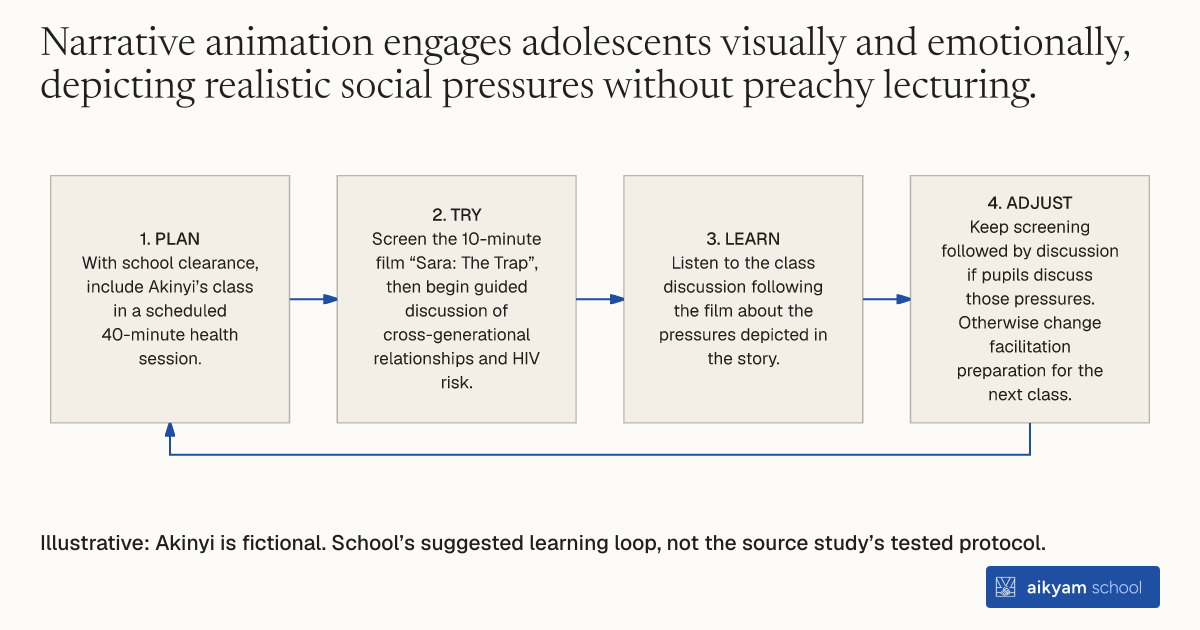
- Plan: With school clearance, include Akinyi’s class in a scheduled 40-minute health session.
- Try: Screen the 10-minute film “Sara: The Trap”, then begin guided discussion of cross-generational relationships and HIV risk.
- Learn: Listen to the class discussion following the film about the pressures depicted in the story.
- Adjust: Keep screening followed by discussion if pupils discuss those pressures. Otherwise change facilitation preparation for the next class.
Illustrative: Akinyi is fictional. School’s suggested learning loop, not the source study’s tested protocol.
See source →Observe discussion after screening. The source evaluated a combined campaign; its outcomes are not evidence for the video alone. School’s suggested learning loop; not a tested source procedure.
How
When to use
Adolescent girls often face pressure from wealthy adult men who offer gifts or money in exchange for sexual favors. Standard educational lectures can fail to engage youth or adequately convey the subtle exploitation involved in transactional relationships. Screening a narrative animated video provides a relatable visual story that helps primary students identify and discuss the dangers of sugar daddy relationships.
Screen a 10-minute animated narrative video in upper-primary classrooms to spark peer discussions on resisting transactional sexual relationships with older men.
- NGO facilitators visit primary school classrooms during a scheduled 40-minute health session with administrator clearance.
- Facilitators set up audio-visual equipment and introduce the narrative context of transactional relationships and sugar daddies.
- Facilitators play the 10-minute animated educational film "Sara: The Trap" for the assembled classroom.
- Students watch the animated story depicting a teenage girl named Sara who resists material bribes and sexual coercion from an older shopkeeper with help from peers.
- Project officers use the video narrative as an immediate stimulus to launch open guided discussions on cross-generational relationships and HIV risk.
Why it works
Seeing peer characters successfully expose manipulative older men encourages teenagers to recognize transactional traps and seek support from friends.
Example
In 71 primary schools across Western Kenya, NGO project officers screened the 10-minute UNICEF animated film "Sara: The Trap" to eighth-grade students in 2004. Combined with relative risk discussions, the intervention contributed to a 61.7 percent drop in pregnancies fathered by men over five years older.
About the study
Participants
71 treatment primary schools and 257 comparison primary schools in Western Kenya, covering eighth-grade students with an average age of 15 years.
Study Design
A randomized controlled trial evaluated the video screening as the opening component of a 40-minute relative risk campaign, measuring 12-month childbearing incidence and partner age gaps.
Results
The combined campaign featuring the video screening reduced overall teenage pregnancies by 28 percent (a 1.5 percentage point drop from a 5.4 percent baseline) and reduced pregnancies fathered by men over five years older by 61.7 percent.