Research procedure
Measure beliefs before health education
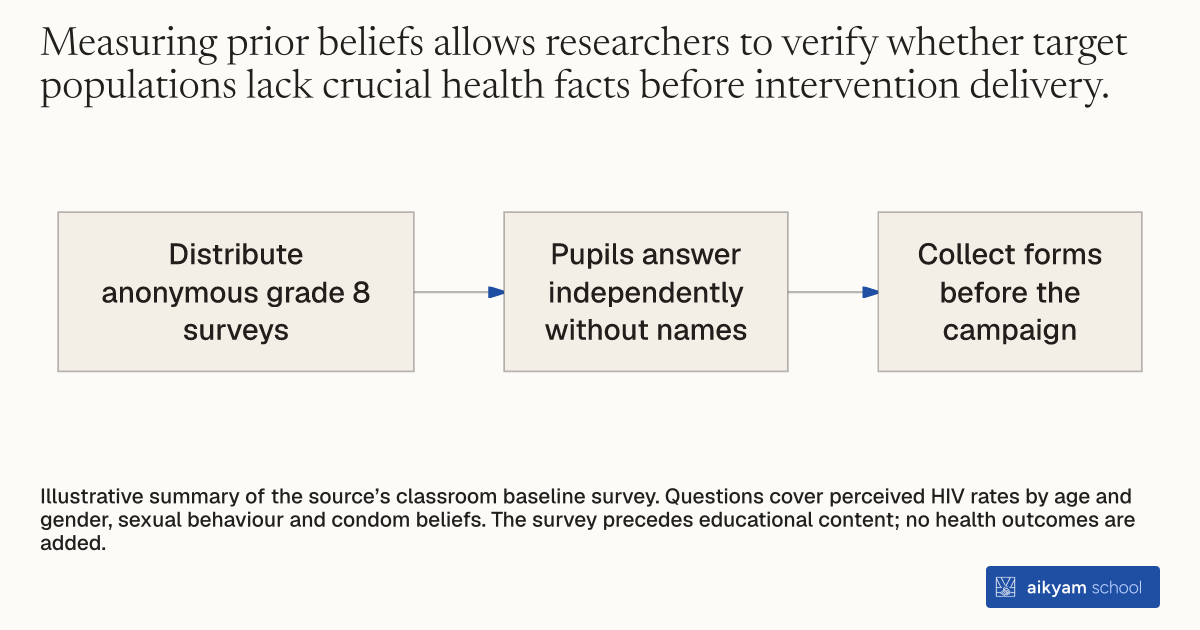
- Distribute anonymous grade 8 surveys
- Pupils answer independently without names
- Collect forms before the campaign
Illustrative summary of the source’s classroom baseline survey. Questions cover perceived HIV rates by age and gender, sexual behaviour and condom beliefs. The survey precedes educational content; no health outcomes are added.
See source →How
When to use
Public health planners often design youth disease awareness campaigns without knowing students' baseline risk perceptions. Adolescents may harbor severe misperceptions about demographic risk profiles, making standard warnings ineffective. This diagnostic method assesses students' prior beliefs regarding age and gender disease patterns to identify knowledge gaps before launching targeted health communications.
Administer an anonymous self-administered paper survey to upper-primary students prior to health education sessions to diagnose baseline risk perceptions.
- Project officers visit grade 8 primary classrooms with school administrator authorization before initiating educational campaigns.
- Officers distribute standardized, anonymous paper survey questionnaires directly to all attending pupils.
- Facilitators instruct students to complete the self-administered questionnaire independently without writing identifying names.
- Survey questions prompt pupils on their beliefs regarding HIV infection rates across different age groups and genders.
- Questions assess self-reported sexual behavior, condom efficacy beliefs, and perceptions of classmate non-student partnerships.
- Officers collect completed forms immediately to quantify baseline misperceptions and evaluate intervention effectiveness.
Why it works
Anonymity encourages honest self-reporting on sensitive sexual behaviors and personal beliefs without fear of social judgment or school disciplinary action.
Example
In 71 primary schools across Western Kenya, NGO project officers surveyed 1,176 eighth-grade girls and 1,246 eighth-grade boys in 2004 prior to a relative risk campaign. The survey revealed that only 29 percent of girls and 25 percent of boys knew that men over 25 faced higher HIV infection rates than teenage boys.
About the study
Participants
2,422 eighth-grade primary students (1,176 girls with average age 15.1 years and 1,246 boys with average age 15.5 years) across 71 primary schools in Western Kenya.
Study Design
A baseline diagnostic survey administered anonymously in classrooms immediately prior to the relative risk information session to capture prior beliefs and sexual behavior statistics.
Results
The survey established that only 29 percent of girls and 25 percent of boys recognized older men's higher HIV risk, 21 percent of girls and 48 percent of boys reported sexual activity, and 45 percent of girls and 66 percent of boys believed condoms prevent HIV.