Research design
Assign villages before recruiter visits
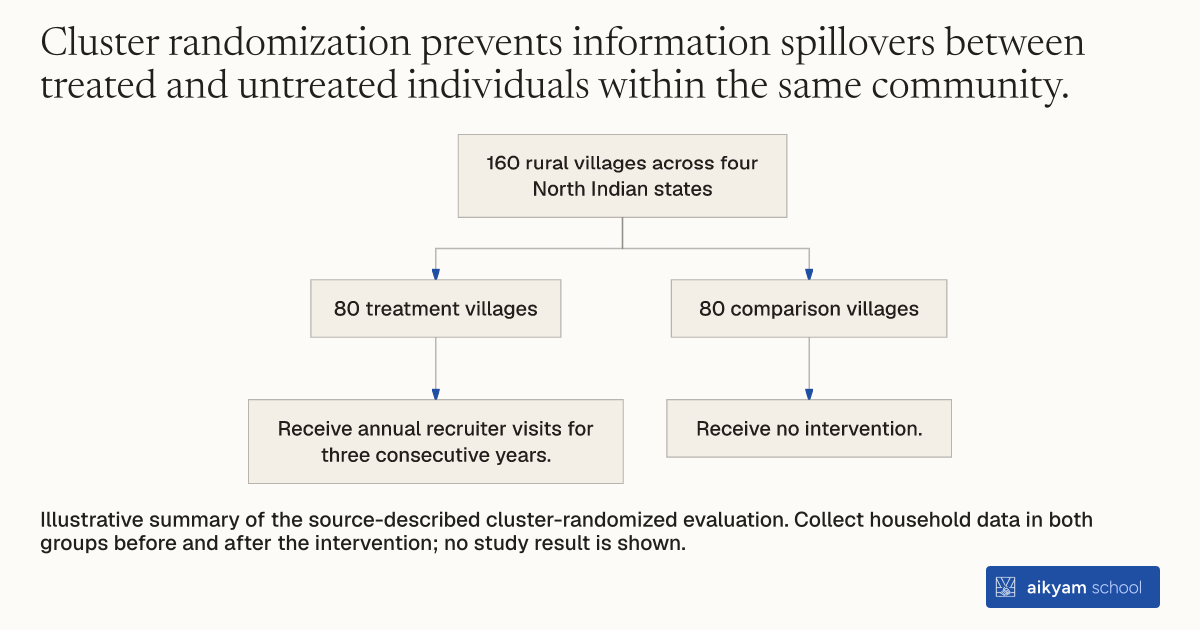
160 rural villages across four North Indian states
- 80 treatment villages
- Receive annual recruiter visits for three consecutive years.
- 80 comparison villages
- Receive no intervention.
Illustrative summary of the source-described cluster-randomized evaluation. Collect household data in both groups before and after the intervention; no study result is shown.
See source →How
When to use
When measuring the causal impact of community-level economic interventions, individual randomization causes spillover effects among neighbors. This method evaluates program efficacy by randomizing at the village cluster level across geographic regions. It allows researchers to measure clean treatment effects on female labor, education, and health outcomes.
Evaluate program impact by randomly assigning geographic clusters to treatment or comparison groups.
- Researchers select 160 rural villages located 50 to 150 km from an urban center across four states.
- Researchers randomly assign 80 villages to the treatment group and 80 villages to the comparison group.
- Recruiters deliver the intervention exclusively in treatment villages annually for three consecutive years.
- Researchers leave comparison villages without intervention to serve as a control group.
- Surveyors gather household data across treatment and comparison villages before and after the intervention window.
Why it works
Comparing baseline and endline survey data across randomly assigned village clusters isolates the true causal impact of the intervention.
Example
Researchers assigned 160 rural villages in North India into 80 treatment and 80 comparison villages. Over three years, treatment villages showed a 4.6 percentage point increase in BPO employment among women aged 18 to 24 and a 5 percentage point increase in girl school enrollment relative to comparison villages.
About the study
Participants
160 rural villages (80 treatment, 80 comparison) and 3,200 households across Haryana, Punjab, Rajasthan, and Uttar Pradesh, India.
Study Design
Cluster randomized evaluation comparing 80 treatment villages receiving annual recruiter visits against 80 comparison villages.
Results
Women aged 18 to 24 in treatment villages were 4.6 percentage points more likely to be employed in BPO jobs, and girls aged 6 to 17 were 5 percentage points more likely to be enrolled in school.