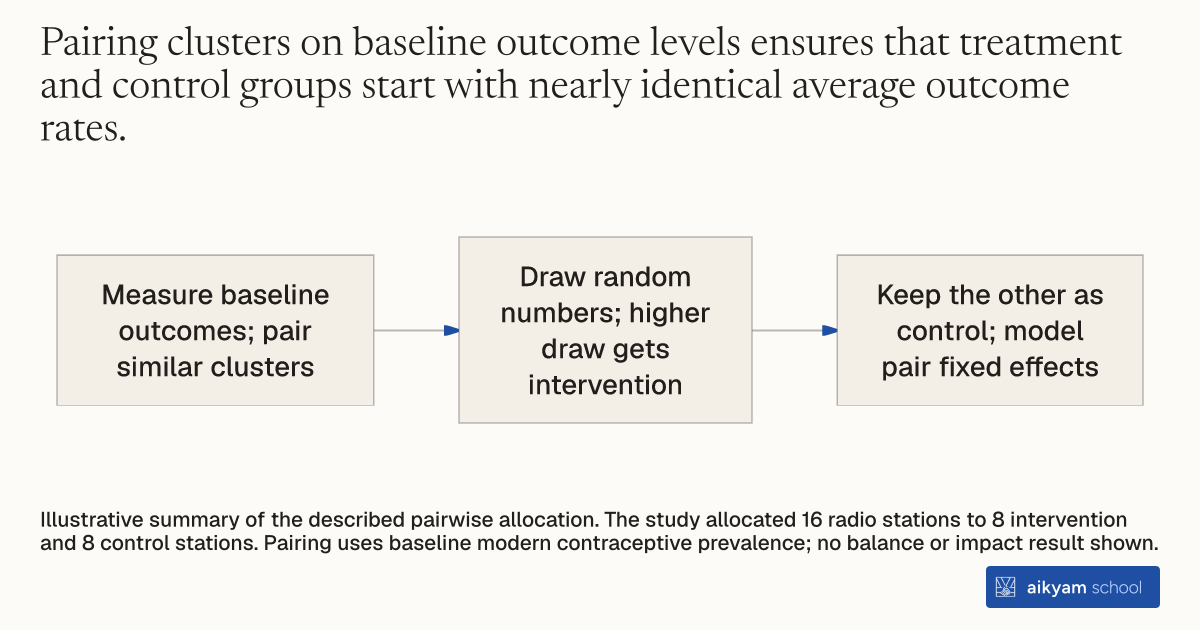
Research steps
Randomise within matched pairs
- Measure baseline outcomes; pair similar clusters
- Draw random numbers; higher draw gets intervention
- Keep the other as control; model pair fixed effects
Illustrative summary of the described pairwise allocation. The study allocated 16 radio stations to 8 intervention and 8 control stations. Pairing uses baseline modern contraceptive prevalence; no balance or impact result shown.
See source →How
When to use
In cluster randomized experiments with a small number of available clusters, simple random assignment risks severe baseline imbalance between treatment and control groups. Researchers and program evaluators want to maximize statistical power and ensure comparable baseline characteristics across treatment arms. Pairing similar clusters on baseline primary outcomes before randomizing within each pair resolves small-sample imbalance.
Pairwise randomize clusters based on pre-treatment outcome levels to balance treatment assignment in small-sample cluster trials.
- Collect baseline survey data across all candidate cluster units to measure primary outcome variables.
- Rank and group all candidate clusters into pairs based on similarity in baseline primary outcome prevalence.
- Assign a random number to each cluster within every matched pair using statistical software.
- Allocate the cluster with the higher random draw in each pair to the intervention group.
- Assign the remaining cluster in each pair to the control group.
- Include pair fixed-effect indicator variables in all downstream outcome regression specifications to preserve randomization design.
Why it works
Controlling for pair fixed effects in downstream regressions absorbs cross-pair variance and increases statistical precision.
Example
In Burkina Faso, evaluators pairwise randomized 16 community radio stations into 8 treatment stations and 8 control stations covering 5.1 million people. Stations were paired based on baseline modern contraceptive prevalence rates across surrounding villages before random assignment. This pairwise stratification achieved baseline balance across treatment and control clusters for modern contraceptive prevalence (23 percent in control vs 24.2 percent in treatment).
About the study
Participants
16 radio station clusters covering 252 villages, 7,515 women, and 5.1 million inhabitants in rural Burkina Faso.
Study Design
Pairwise stratified cluster randomization based on baseline modern contraceptive prevalence rate.
Results
Pairwise randomization achieved baseline balance on modern contraceptive prevalence (23 percent control vs 24.2 percent treatment, p-value = 0.52) and enabled detection of a 5.9 percentage point campaign impact.