Research allocation
Compare village price-information groups
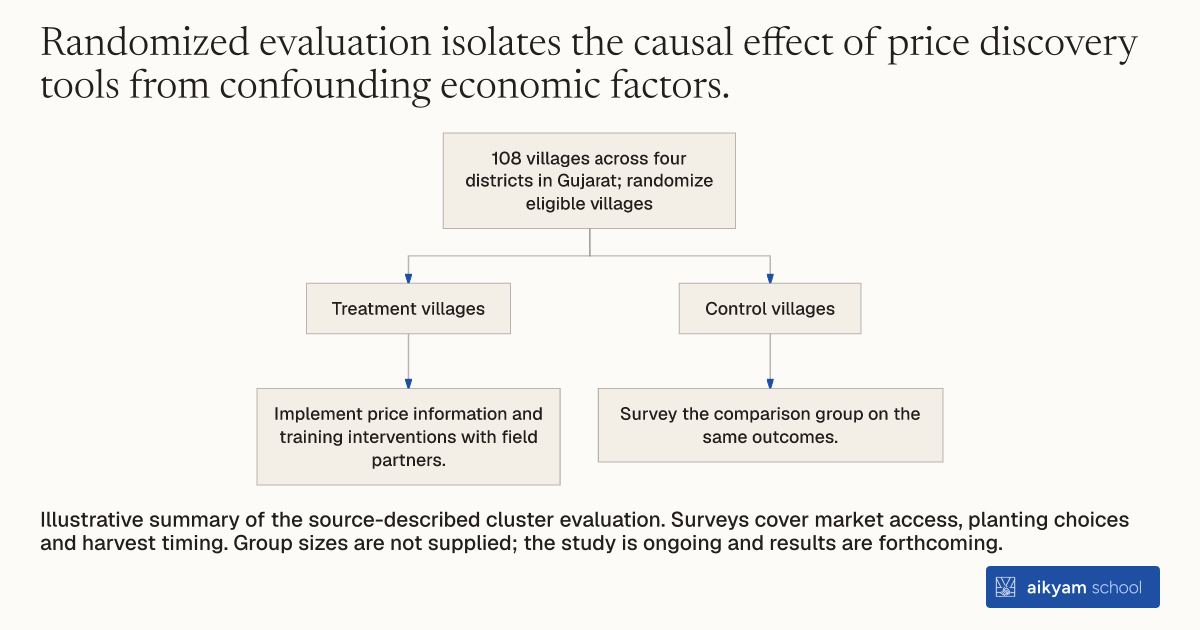
108 villages across four districts in Gujarat; randomize eligible villages
- Treatment villages
- Implement price information and training interventions with field partners.
- Control villages
- Survey the comparison group on the same outcomes.
Illustrative summary of the source-described cluster evaluation. Surveys cover market access, planting choices and harvest timing. Group sizes are not supplied; the study is ongoing and results are forthcoming.
See source →How
When to use
Agricultural communities face severe price uncertainty that hinders investment and keeps households in poverty. Measuring whether price transparency interventions reduce this economic risk requires rigorous empirical testing across rural communities. Researchers use cluster randomized evaluation to measure the impact of price information programs on farmer market access and decision-making.
Measure the impact of price transparency interventions using a cluster randomized evaluation across rural villages.
- Select target agricultural districts and list eligible rural villages in the study region.
- Randomize eligible villages into treatment groups receiving price information and control groups.
- Partner with local field organizations to implement market information and training interventions in treatment villages.
- Survey farming households across treatment and control villages to measure outcomes including market access, planting choices, and harvest timing.
Why it works
Comparing treatment and control villages allows researchers to measure how information influences market access and planting choices.
Example
Researchers from J-PAL, SEWA, and CMF conducted a randomized evaluation across 108 villages in 4 districts of Gujarat, India, to test price dissemination and training interventions targeting farmers.
About the study
Participants
108 villages in 4 districts of Gujarat, India, targeting farmers.
Study Design
Randomized evaluation conducted by J-PAL researchers in partnership with SEWA and CMF.
Results
Study ongoing; results forthcoming.