Research steps
Account for incomplete contract rollout
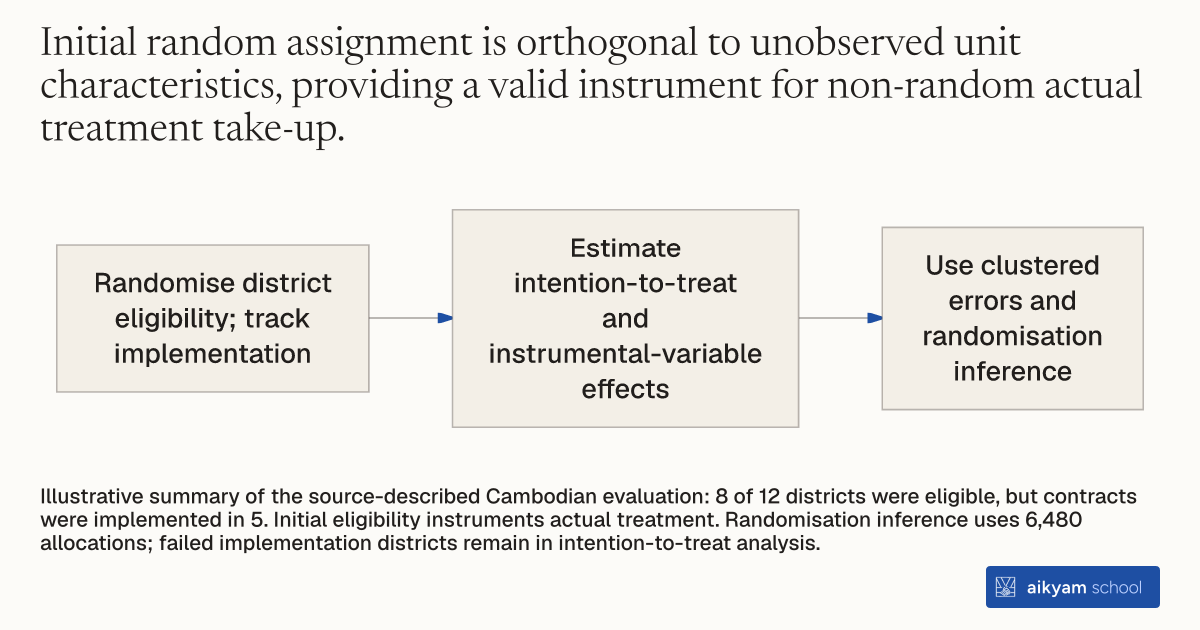
- Randomise district eligibility; track implementation
- Estimate intention-to-treat and instrumental-variable effects
- Use clustered errors and randomisation inference
Illustrative summary of the source-described Cambodian evaluation: 8 of 12 districts were eligible, but contracts were implemented in 5. Initial eligibility instruments actual treatment. Randomisation inference uses 6,480 allocations; failed implementation districts remain in intention-to-treat analysis.
See source →How
When to use
Field evaluations of social programs often face selective implementation when randomized assignment is incomplete or units drop out. Simple comparisons between treated and comparison units create selection bias if units that take up treatment differ systematically from those that do not. Evaluate program impacts using initial cluster-level random assignment as an instrumental variable for actual treatment status.
Evaluate program impacts across aggregate units using initial cluster-level random eligibility as an instrumental variable for actual treatment rollout.
- Assign aggregate geographic units randomly to treatment eligibility and comparison groups using stratified or quasi-stratified draws.
- Solicit bids or rollout proposals for treatment units while maintaining standard operations in comparison units.
- Track actual program implementation across all randomly assigned eligibility units, including those where implementation fails.
- Estimate intention-to-treat effects across all randomly assigned units regardless of actual implementation status.
- Estimate treatment-on-the-treated effects using initial random assignment as an instrumental variable for actual treatment status.
- Calculate standard errors using cluster-correlated estimators and exact randomization inference over all possible placebo allocations.
Why it works
Instrumental variable estimation isolates the exogenous variation in treatment caused by random eligibility, purging selection bias from non-responsive units.
Example
In Cambodia, 8 of 12 study districts were randomly selected as eligible for health management contracts, but acceptable bids were received in only 5 districts. Researchers used initial random eligibility as an instrumental variable for actual contract rollout across 360 sample villages. This instrumental variable approach showed that contracting increased public facility use for curative care by 18 to 29 percentage points without selection bias.
About the study
Participants
12 rural health districts across Takeo, Prey Veng, and Kampong Cham provinces in Cambodia, covering 1.26 million residents in 360 villages with 3,700 households and 143 health centers.
Study Design
Cluster-randomized evaluation using initial 8-district random eligibility as an instrumental variable for actual 5-district contract implementation, evaluated with clustered standard errors and 6,480-combination randomization inference.
Results
Using initial random assignment as an instrument for treatment showed average targeted outcome improvements of 0.51 standard deviations for contracting in and 0.54 standard deviations for contracting out, with 6,480 placebo allocations providing exact p-values (p = 0.03 and p = 0.02).