Research procedure
Estimate effects allowing for non-attendance
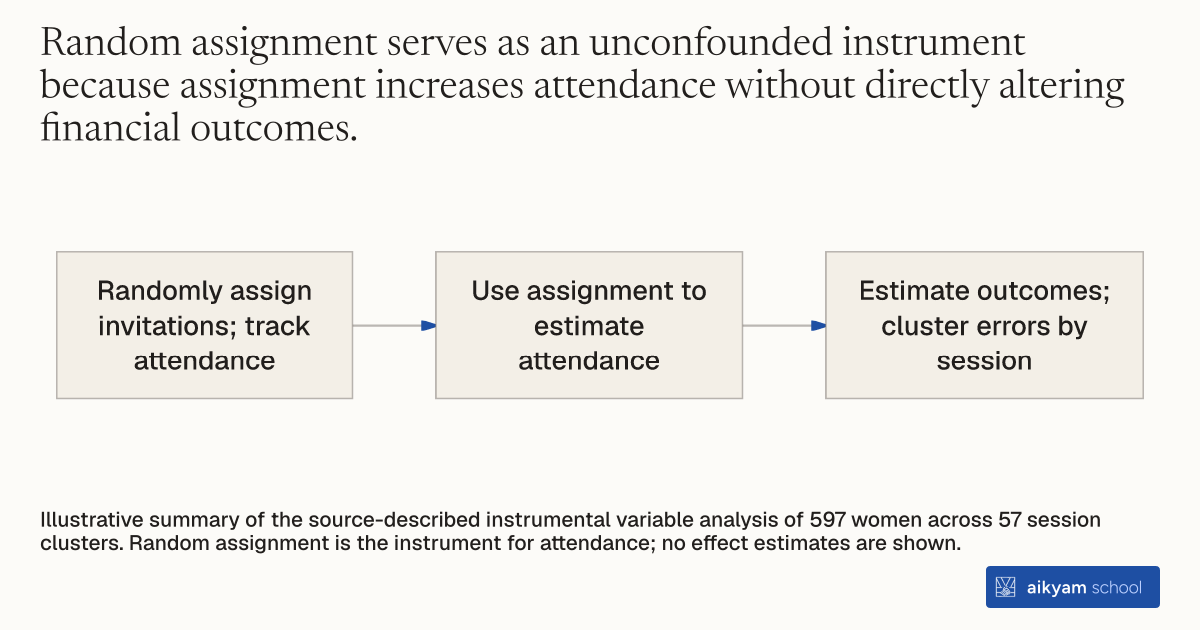
- Randomly assign invitations; track attendance
- Use assignment to estimate attendance
- Estimate outcomes; cluster errors by session
Illustrative summary of the source-described instrumental variable analysis of 597 women across 57 session clusters. Random assignment is the instrument for attendance; no effect estimates are shown.
See source →How
When to use
When evaluating social programs, invited participants do not always attend training sessions. Measuring simple differences between attending and non-attending participants introduces selection bias. Estimating treatment-on-the-treated impacts using randomized invitation assignment as an instrumental variable isolates the true effect of training on those who attend.
Estimate program impacts on participants using randomized treatment assignment as an instrument for session attendance.
- Assign eligible study participants to treatment or control groups through random assignment.
- Track session attendance for all participants to identify who actually completes the training.
- Use the initial randomized assignment status as an instrumental variable for session attendance in the first-stage regression.
- Estimate the treatment-on-the-treated impact in the second-stage regression on financial and business outcomes.
- Cluster standard errors at the training session level to adjust for within-cohort peer effects.
Why it works
Using this instrument removes non-random self-selection bias between attendees and non-attendees.
Example
In Ahmedabad, India, researchers used initial random assignment as an instrument for training attendance among 597 female microfinance clients across 57 session clusters, estimating a statistically significant 13 percentage point increase in loan take-up among upper-caste Hindu attendees.
About the study
Participants
N = 597 female microfinance clients (346 Upper Caste Hindu, 70 Scheduled Caste Hindu, 181 Muslim) aged 18 to 50 in Ahmedabad, India.
Study Design
Instrumental variable treatment-on-the-treated (TOT) regressions using randomized training invitation as an instrument for attendance, with standard errors clustered across 57 session cohorts.
Results
Instrumental variable TOT estimation revealed that business training increased loan take-up by 13 percentage points (p < 0.05) and labor market activity by 19 percentage points (p < 0.01) among upper-caste Hindu women, while treatment effects were 37 percentage points lower for Scheduled Caste women (p < 0.001) and 22 percentage points lower for Muslim women (p < 0.05).