Research procedure
Compare changes in land rights over time
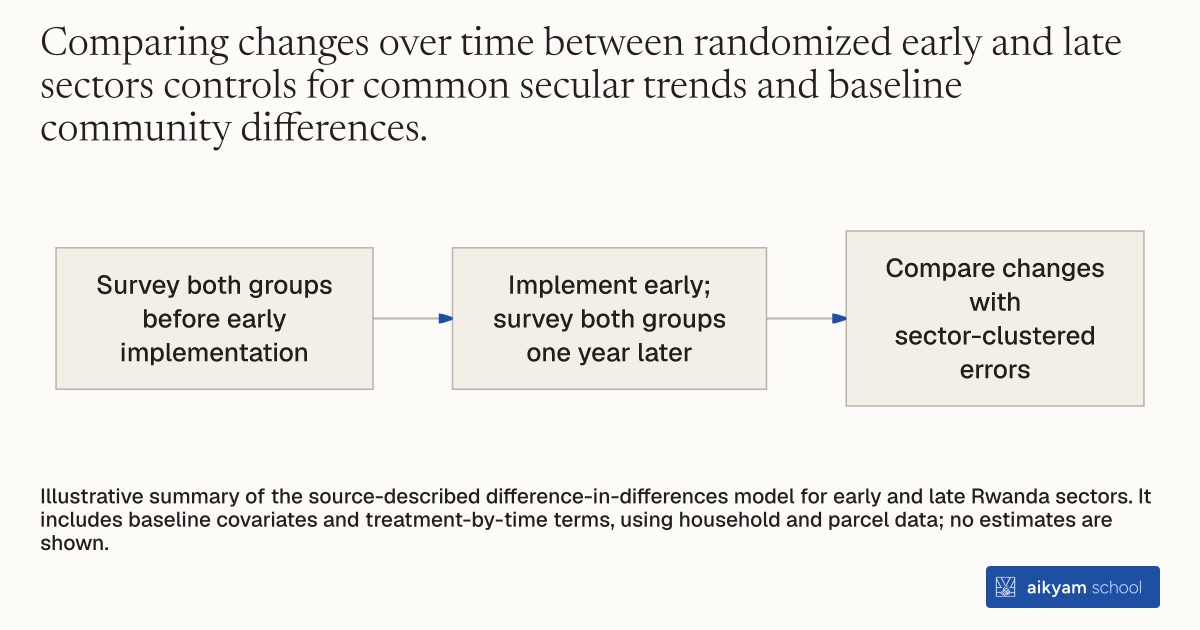
- Survey both groups before early implementation
- Implement early; survey both groups one year later
- Compare changes with sector-clustered errors
Illustrative summary of the source-described difference-in-differences model for early and late Rwanda sectors. It includes baseline covariates and treatment-by-time terms, using household and parcel data; no estimates are shown.
See source →How
When to use
Governments introducing broad land tenure reforms need to evaluate whether titling genuinely strengthens property security and gender equity. Standard observational comparisons can be confounded by baseline differences across communities or nationwide trends over time. Researchers apply a difference-in-differences empirical model to estimate how land regularization changes tenure security and women's rights.
Estimate land program impacts by comparing changes in outcome variables over time between randomized early treatment sectors and late control sectors.
- Evaluators collect baseline household, individual, and parcel survey data across treatment and control sectors prior to program implementation.
- Program teams implement land demarcation and adjudication in early treatment sectors.
- Evaluators conduct a follow-up household survey in both early and late sectors one year after baseline.
- Econometricians construct parcel-level and household-level regression models containing treatment indicators, time dummies, and interaction terms.
- Econometricians include baseline covariates such as land acquisition mode, female headship, and legal marriage status to control for underlying differences.
- Researchers adjust robust standard errors by clustering them at the sector level to evaluate statistically significant impact estimates.
Why it works
This allows evaluators to isolate the true causal impact of systematic land titling on perceived tenure risks and women's property rights.
Example
Researchers from the World Bank and local partners evaluated Rwanda's land tenure regularization program across 100 rural sectors. The difference-in-differences evaluation revealed that land tenure regularization increased perceived female land registration rights on married couple parcels by 19 to 34 percentage points.
About the study
Participants
3,600 households across 13,416 parcels in 300 villages across 100 rural sectors in Rwanda.
Study Design
Difference-in-differences econometric model comparing early treatment sectors to late control sectors using baseline and 1-year follow-up panel surveys with standard errors clustered at the sector level.
Results
The reform reduced land disagreements by 4 to 5 percentage points, increased female claimant registration rights by 19 to 34 percentage points, and raised female mortgaging rights by 9 to 13 percentage points.