Try, learn and adjust
Check use of commercial analysis
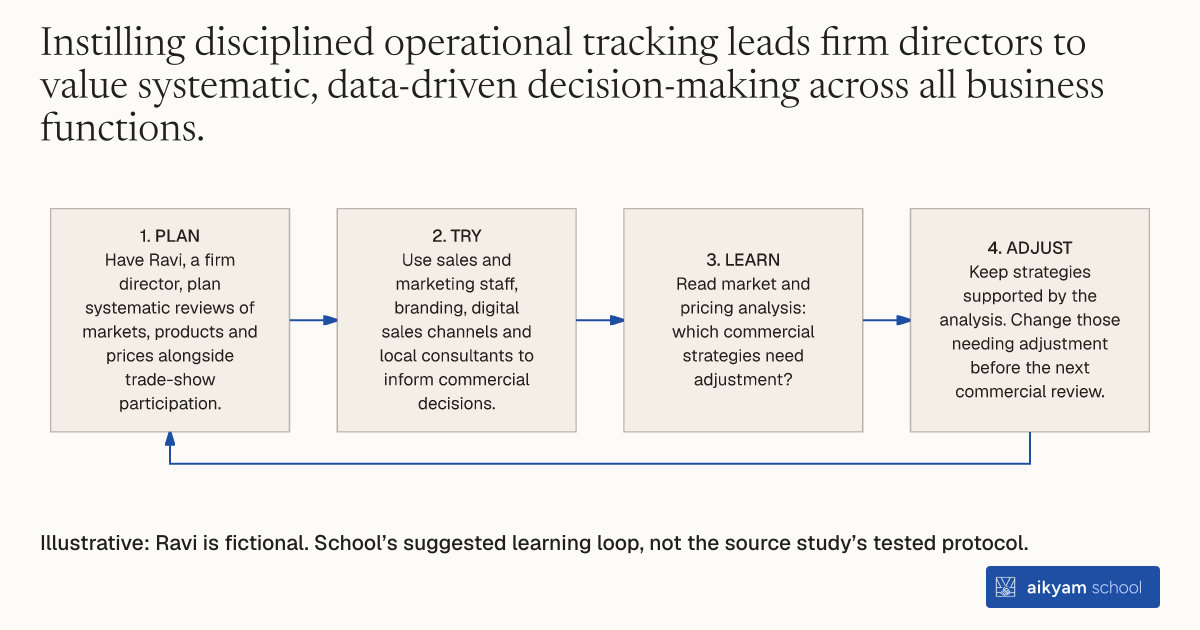
- Plan: Have Ravi, a firm director, plan systematic reviews of markets, products and prices alongside trade-show participation.
- Try: Use sales and marketing staff, branding, digital sales channels and local consultants to inform commercial decisions.
- Learn: Read market and pricing analysis: which commercial strategies need adjustment?
- Adjust: Keep strategies supported by the analysis. Change those needing adjustment before the next commercial review.
Illustrative: Ravi is fictional. School’s suggested learning loop, not the source study’s tested protocol.
See source →School’s suggested, untested loop: observe analysis and documented strategy adjustments; do not infer sales gains or isolate consulting effects.
How
When to use
Manufacturing firms that stabilize basic factory operations often continue to rely on informal, unsystematic commercial and marketing routines. This method applies a structured, data-driven approach across sales, product portfolio analysis, and external commercial advisory services. It helps firm directors and sales executives expand disciplined decision-making from shop-floor operations into commercial and market expansion functions.
Apply a structured data-driven management framework to commercial operations, marketing analysis, and targeted local advisory engagements.
- Direct company executives to regularly attend industry trade shows to observe market trends and build commercial relationships.
- Conduct systematic analysis of target markets, product lines, and pricing structures to evaluate and adjust commercial strategies.
- Establish a dedicated corporate brand and hire qualified sales and marketing professionals to oversee commercial operations.
- Adopt digital commerce tools by using e-commerce platforms for product sales and social media channels for targeted advertising.
- Hire specialized local commercial consultants to advise on loom-changing practices, fabric selection, and market positioning.
Why it works
Observing concrete performance gains in production encourages leadership to extend structured management methods into commercial sales and marketing.
Example
Following a 2008–2010 factory operational intervention, family-owned Indian weaving firms near Mumbai systematically expanded modern commercial practices and hired local advisory services. By 2017, treated firms increased their marketing practice adoption score by 2.965 points on a 7-practice scale and increased commercial consulting usage by 2.491 log days compared to control firms.
About the study
Participants
28 manufacturing plants across 17 family-owned cotton weaving firms near Mumbai, India, averaging 270 employees, \$8.5 million in assets, and \$7.5 million in annual sales.
Study Design
Intention-to-Treat (ITT) panel regressions with firm and year fixed effects across four survey waves (2008, 2011, 2014, and 2017) measuring a 7-point marketing practice score and log commercial consulting days.
Results
Treated firms significantly increased marketing practice adoption by 2017 (+2.965 score, p=0.068) and increased paid commercial consulting usage (+2.491 log days, p=0.098), demonstrating cross-practice management spillovers from shop-floor operations into commercial functions.