Try, learn and adjust
Use defect records to choose corrective action
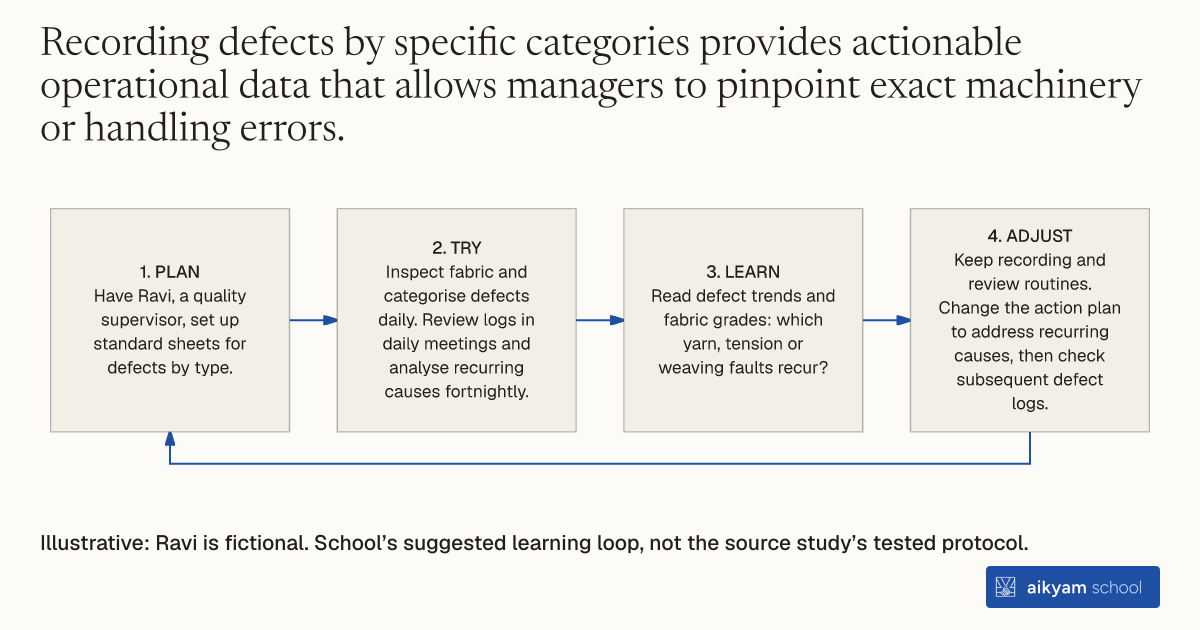
- Plan: Have Ravi, a quality supervisor, set up standard sheets for defects by type.
- Try: Inspect fabric and categorise defects daily. Review logs in daily meetings and analyse recurring causes fortnightly.
- Learn: Read defect trends and fabric grades: which yarn, tension or weaving faults recur?
- Adjust: Keep recording and review routines. Change the action plan to address recurring causes, then check subsequent defect logs.
Illustrative: Ravi is fictional. School’s suggested learning loop, not the source study’s tested protocol.
See source →School’s suggested, untested loop: observe defect categories, trends and action plans; improvement is checked, not assumed.
How
When to use
Manufacturing plants often track aggregate defect counts without categorizing specific defect types or reviewing logs daily. This method establishes systematic defect logging by type and regular quality analysis for factory supervisors and plant managers. It enables production teams to identify root causes of product flaws and take immediate corrective action on the shop floor.
Implement a defect-wise quality recording and daily review protocol to track fabric flaws and execute corrective operational action plans.
- Quality checkers inspect woven fabric daily and log every quality defect on standardized paper recording sheets according to its specific defect type.
- Quality supervisors categorize and aggregate defect data daily by specific categories like yarn breaks, tension faults, and weaving errors.
- Plant managers and quality supervisors meet daily to review defect logs, monitor defect trends, and evaluate fabric gradation scores across production lines.
- Supervisors analyze aggregated defect data fortnightly to identify systemic machinery or process breakdowns causing recurring defects.
- Production teams formulate and execute targeted operational action plans to address root causes and prevent defect recurrence.
Why it works
Regular daily reviews prevent minor quality flaws from cascading into major fabric scrap and costly manual repairs.
Example
During the 2008–2010 consulting intervention in Indian textile plants near Mumbai, consultants introduced defect-wise quality recording across experimental weaving facilities. Defect-wise recording rose from 25% of plants at baseline to 85% in 2011 and 95% in 2017, with zero adopting plants dropping the practice over nine years.
About the study
Participants
28 manufacturing plants across 17 family-owned cotton weaving firms near Mumbai, India, averaging 270 employees, \$8.5 million in assets, and \$7.5 million in annual sales.
Study Design
Randomized Controlled Trial (RCT) tracking 38 management practices across treatment and control plants from 2008 to 2017.
Results
Defect-wise quality recording increased from 25% pre-intervention to 85% in 2011 and reached 95% in 2017, while daily quality monitoring meetings increased from 15% in 2008 to 75% in 2011 before settling at 30% in 2017.