Try, learn and adjust
Check community solar outreach and installations
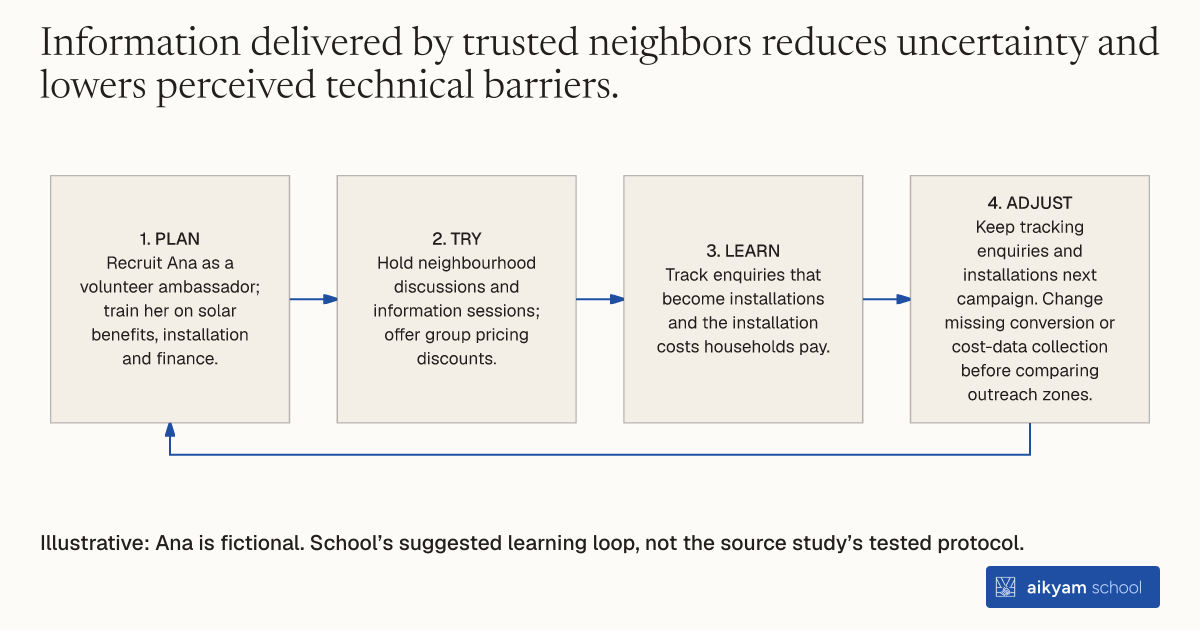
- Plan: Recruit Ana as a volunteer ambassador; train her on solar benefits, installation and finance.
- Try: Hold neighbourhood discussions and information sessions; offer group pricing discounts.
- Learn: Track enquiries that become installations and the installation costs households pay.
- Adjust: Keep tracking enquiries and installations next campaign. Change missing conversion or cost-data collection before comparing outreach zones.
Illustrative: Ana is fictional. School’s suggested learning loop, not the source study’s tested protocol.
See source →School’s suggested learning loop: observe enquiries, installations and costs. School’s loop does not separate peer learning effects from group discounts.
How
When to use
Municipalities face slow residential rooftop solar adoption due to high perceived installation risks and lack of familiarity. Conventional marketing outreach fails to overcome household hesitancy and high customer acquisition costs. Peer outreach programs deploy trained community ambassadors to leverage social learning networks across residential neighborhoods.
Recruit and train community ambassadors to promote residential rooftop solar adoption through social learning networks.
- Identify enthusiastic local residents and community leaders to serve as volunteer solar ambassadors.
- Train community ambassadors on rooftop solar benefits, installation procedures, and available financing options.
- Organize neighborhood information sessions and peer-to-peer discussions led by community ambassadors.
- Offer group pricing discounts to lower solar equipment purchasing and installation costs for participating households.
- Track solar inquiry conversion rates and new residential panel installations across ambassador outreach zones.
Why it works
Social learning creates positive peer influence that encourages nearby homeowners to adopt renewable energy.
Example
Recruitment campaigns in Connecticut deployed community ambassadors and group pricing models across local neighborhoods. The peer-led campaigns successfully increased rooftop solar adoption rates while lowering installation expenses for participating households.
About the study
Participants
Residential property owners across participating municipalities in Connecticut.
Study Design
Randomized controlled trial and natural field experiments evaluating peer social learning and group pricing campaigns.
Results
Using community ambassadors and social learning approaches significantly boosted residential rooftop solar adoption, while group pricing models successfully reduced installation costs for homeowners.