Try, learn and adjust
Check solar trading reports and peer interest
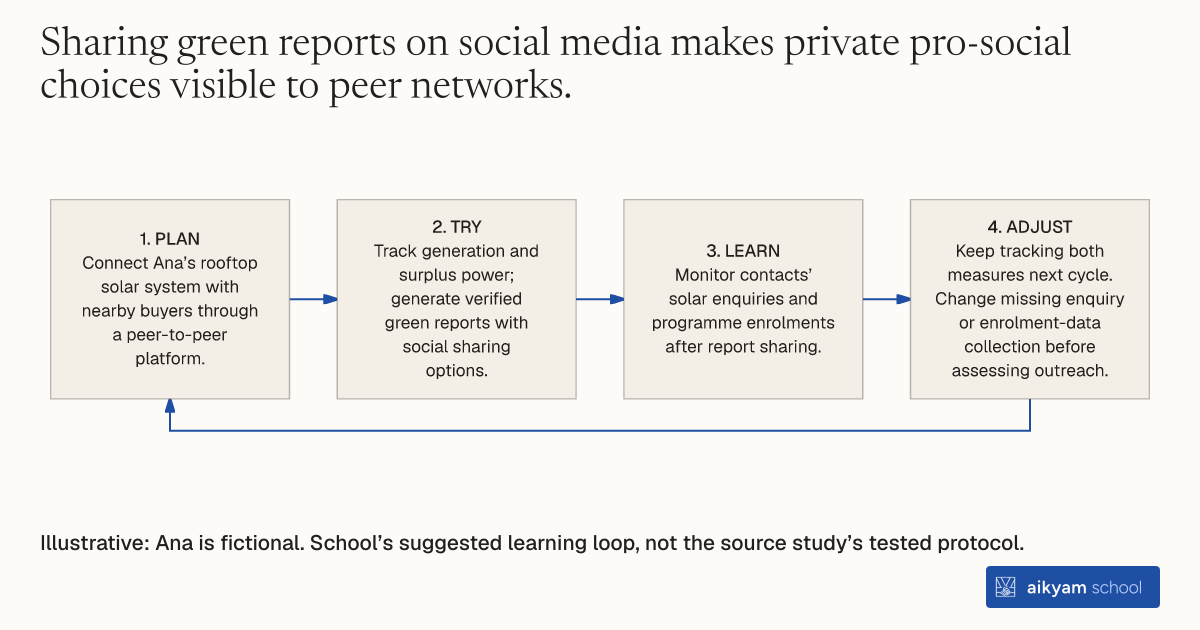
- Plan: Connect Ana’s rooftop solar system with nearby buyers through a peer-to-peer platform.
- Try: Track generation and surplus power; generate verified green reports with social sharing options.
- Learn: Monitor contacts’ solar enquiries and programme enrolments after report sharing.
- Adjust: Keep tracking both measures next cycle. Change missing enquiry or enrolment-data collection before assessing outreach.
Illustrative: Ana is fictional. School’s suggested learning loop, not the source study’s tested protocol.
See source →School’s suggested learning loop: observe generation, shared reports, enquiries and enrolment. Interest in adoption is not the same as installed solar capacity.
How
When to use
Residential clean energy programs encounter slow adoption because rooftop solar installations remain hidden private choices. Homeowners rarely discuss power generation with neighbors or understand local trading options. Peer-to-peer energy platforms allow solar owners to sell excess electricity to neighbors while broadcasting green reports online.
Enable rooftop solar system owners to sell surplus clean power to neighbors and share verified green reports on social networks.
- Deploy a digital peer-to-peer trading platform connecting solar households with nearby energy buyers.
- Track real-time solar generation and excess electricity fed into the local grid.
- Generate automated green progress reports summarizing household solar generation and emissions reductions.
- Provide sharing options allowing solar owners to post verified green reports on social media channels.
- Monitor neighboring social media contacts to measure increases in solar inquiry rates and program enrollments.
Why it works
Public visibility leverages social norms to build community trust and motivate neighboring households to adopt renewable energy.
Example
A randomized evaluation in Massachusetts examined peer-to-peer solar programs that enabled rooftop solar owners to sell excess energy to neighbors. System owners who shared green reports on social media increased adoption interest among neighboring contacts across local social networks.
About the study
Participants
Residential rooftop solar owners and neighboring households in Massachusetts, United States.
Study Design
Randomized controlled trial evaluating peer-to-peer solar energy trading and social media report sharing.
Results
Sharing verified green reports on social media increased local community interest and willingness to adopt residential rooftop solar systems.