Try, learn and adjust
Check community reactions after training
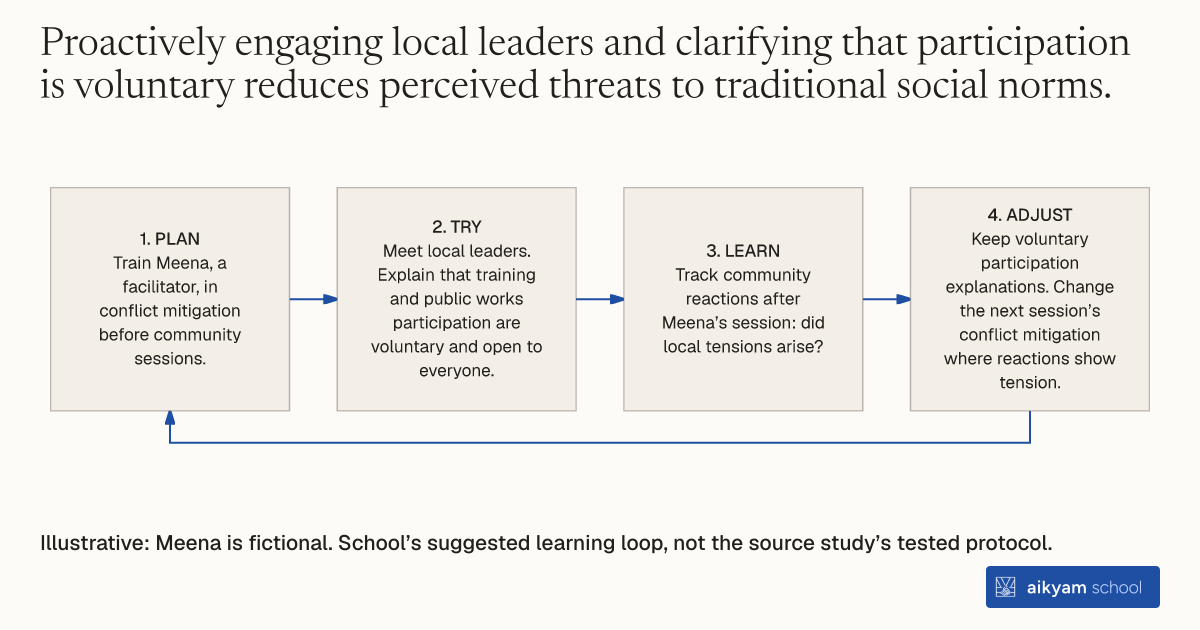
- Plan: Train Meena, a facilitator, in conflict mitigation before community sessions.
- Try: Meet local leaders. Explain that training and public works participation are voluntary and open to everyone.
- Learn: Track community reactions after Meena’s session: did local tensions arise?
- Adjust: Keep voluntary participation explanations. Change the next session’s conflict mitigation where reactions show tension.
Illustrative: Meena is fictional. School’s suggested learning loop, not the source study’s tested protocol.
See source →School’s suggested, untested loop. Observe post-session community reactions; long-term impact results are forthcoming.
How
When to use
In rural communities where traditional norms limit women's mobility and paid work, encouraging women to take on visible economic roles can spark resistance or social friction. This method addresses the risk of community backlash against female labor participation. It provides structured stakeholder engagement and conflict mitigation steps for trainers working with rural local leaders and program participants.
Execute stakeholder engagement and conflict mitigation protocols during employment training to minimize community backlash against working women.
- Program managers train employment facilitators on conflict mitigation protocols prior to launching community training sessions.
- Facilitators meet with local village leaders to explain that training and work scheme participation are entirely voluntary for all residents.
- Trainers emphasize to participants and local leaders that public works programs and training sessions remain open to everyone in the community.
- Facilitators deliver public works administrative training while applying simple conflict resolution steps if local tension arises.
- Field teams track local community reactions immediately following each training session to monitor safety and social dynamics.
Why it works
Tracking post-session community reactions allows program teams to address social friction early before it escalates into active opposition.
Example
In Madhya Pradesh, India, research teams implemented conflict mitigation protocols across 300 Gram Panchayats where trainers delivered public work enrollment training to women across 6,000 surveyed households between July 2025 and March 2026.
About the study
Participants
9,600 households across 480 Gram Panchayats in 90 blocks of rural Madhya Pradesh, India, where 57 percent of surveyed women were aged 15 to 49.
Study Design
Clustered Randomized Controlled Trial across 90 blocks, incorporating voluntary participation framing, local leader engagement, and post-session community reaction tracking across training blocks.
Results
Implementation protocols were established across 300 training Gram Panchayats to safeguard female participants; impact evaluation and long-term reaction tracking are ongoing with results forthcoming.