Try, learn and adjust
Check community health meeting reporting
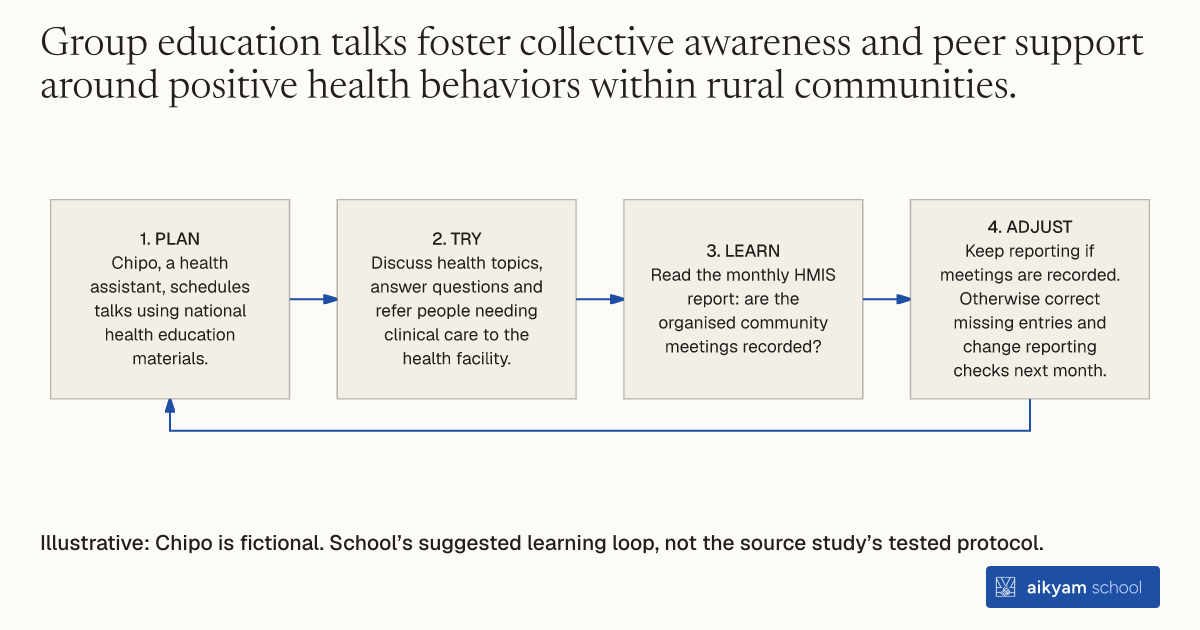
- Plan: Chipo, a health assistant, schedules talks using national health education materials.
- Try: Discuss health topics, answer questions and refer people needing clinical care to the health facility.
- Learn: Read the monthly HMIS report: are the organised community meetings recorded?
- Adjust: Keep reporting if meetings are recorded. Otherwise correct missing entries and change reporting checks next month.
Illustrative: Chipo is fictional. School’s suggested learning loop, not the source study’s tested protocol.
See source →School’s suggested, untested learning loop. Observe meeting counts in monthly reports. This is a delivery check, not evidence of health effects.
How
When to use
Rural communities often lack public health awareness regarding disease prevention, sanitation, and timely medical care. Individual household visits alone may not reach entire villages or encourage collective health practices efficiently. Organizing group health education and community mobilization meetings in local facilities and schools builds shared community health literacy and increases clinical service utilization.
Organize and lead structured group health education talks and community mobilization meetings at local health posts and schools.
- Community Health Assistants schedule regular health education talks at local health posts, community centers, and neighborhood schools.
- Health workers prepare structured presentation materials covering disease prevention, sanitation practices, and maternal care based on national curricula.
- Health workers gather local residents, parents, and community leaders to discuss key health topics such as child nutrition and deworming.
- Health workers answer community health questions and refer participants needing clinical care to the local health center or post.
- Health workers submit monthly administrative reports documenting the number of community meetings organized to the Ministry of Health via HMIS mobile platforms.
Why it works
Direct interaction with trained civil service health staff encourages families to utilize formal health facilities for preventative and curative care.
Example
In rural Zambia, Community Health Assistants organized community mobilization meetings across 146 health post catchment areas over an 18-month deployment period. Recruited health workers in control areas organized an average of 20.32 community meetings. In career treatment districts, health workers organized 37.44 meetings over the same period—representing a 17.12 meeting increase in community mobilization activity.
About the study
Participants
307 deployed Community Health Assistants across 146 reporting health posts in 48 rural districts of Zambia.
Study Design
Cluster-randomized controlled trial measuring monthly administrative HMIS reports submitted by health post staff over an 18-month evaluation period (August 2012 to January 2014).
Results
Health workers in career treatment districts organized 17.12 more community mobilization meetings over 18 months relative to the control group mean of 20.32 (p=0.006).