Try, learn and adjust
Check maternity contributions and disbursements
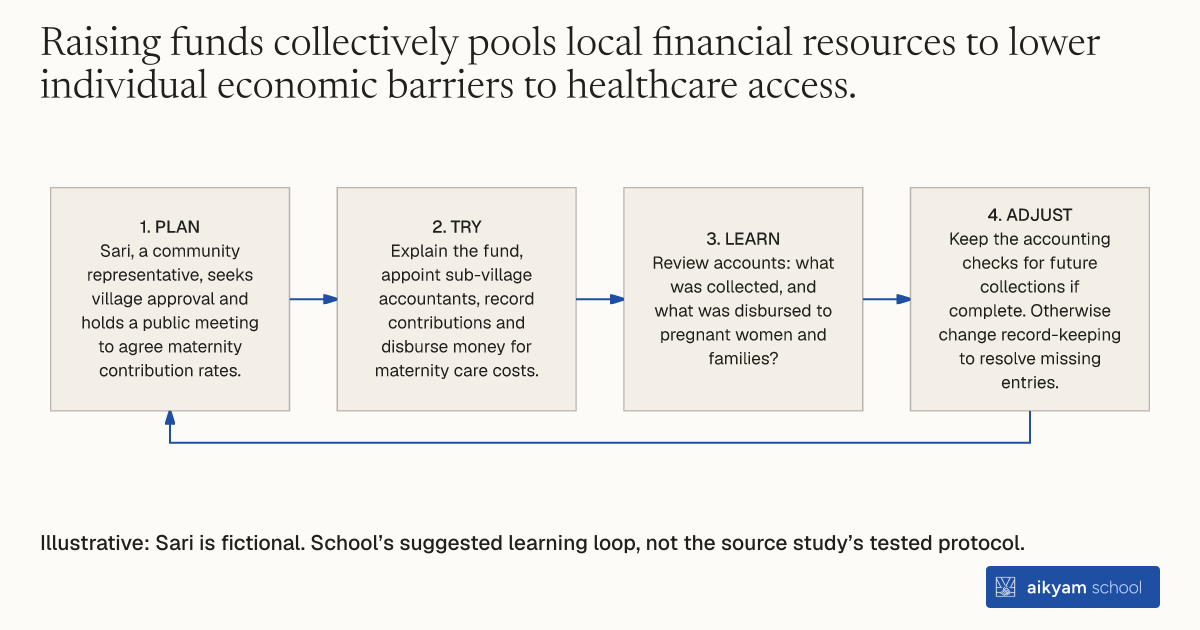
- Plan: Sari, a community representative, seeks village approval and holds a public meeting to agree maternity contribution rates.
- Try: Explain the fund, appoint sub-village accountants, record contributions and disburse money for maternity care costs.
- Learn: Review accounts: what was collected, and what was disbursed to pregnant women and families?
- Adjust: Keep the accounting checks for future collections if complete. Otherwise change record-keeping to resolve missing entries.
Illustrative: Sari is fictional. School’s suggested learning loop, not the source study’s tested protocol.
See source →School's suggested, untested loop: observe agreed contributions, collections and disbursements; no health benefit is assumed.
How
When to use
Rural expectant mothers face healthcare and transportation costs that discourage them from giving birth at health facilities. Local community representatives need a collective fundraising mechanism to support vulnerable families. Organizers deploy this method to collect community contributions that cover facility fees and delivery expenses for pregnant women.
Organize a community-wide fundraising campaign to defray health facility costs for pregnant women.
- Present a maternal health fundraising proposal to village government leaders to obtain official acceptance.
- Convene an open public meeting to discuss health facility costs and agree on community contribution rates.
- Conduct community awareness activities explaining how collected funds directly assist pregnant women and newborns.
- Appoint sub-village accountants to collect, record, and manage monetary contributions across local neighborhoods.
- Disburse collected funds to pregnant women and families to cover facility delivery and care expenses.
Why it works
Establishing transparent accounting roles and securing village council approval builds public trust and encourages regular citizen contributions.
Example
In a Tanzanian intervention village, community representatives developed an eight-step action plan titled "Fundraising to support MNH" to gain village government approval, agree on community contribution rates in an open meeting, and select sub-village accountants to collect and disburse maternity funds for local mothers.
About the study
Participants
200 rural treatment villages across two regions in Indonesia (100 villages) and two regions in Tanzania (100 villages).
Study Design
Two randomized controlled trials evaluating a non-prescriptive civic deliberation initiative, tracking social action plans and goal completion rates over a 90-day intervention period.
Results
Community fundraising was designed by 18.5% of villages overall (16.0% in Indonesia and 21.0% in Tanzania), representing 37.7% of all actions within the increased ability to pay pathway overall (31.3% in Indonesia and 46.0% in Tanzania).