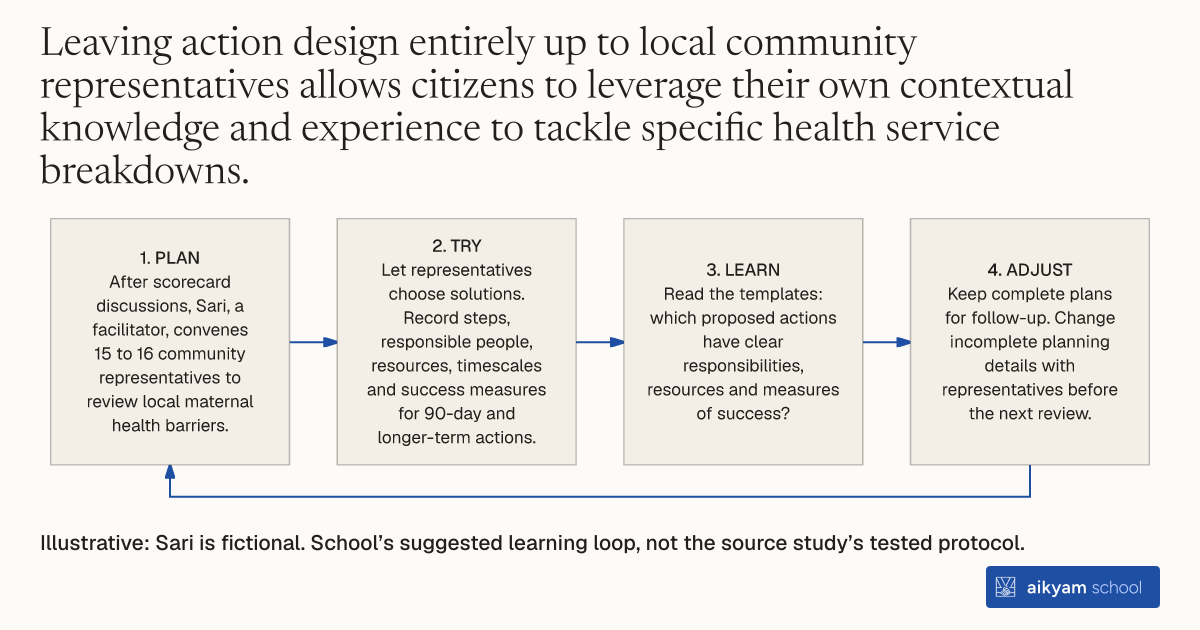
Try, learn and adjust
Check action plans define responsibilities
- Plan: After scorecard discussions, Sari, a facilitator, convenes 15 to 16 community representatives to review local maternal health barriers.
- Try: Let representatives choose solutions. Record steps, responsible people, resources, timescales and success measures for 90-day and longer-term actions.
- Learn: Read the templates: which proposed actions have clear responsibilities, resources and measures of success?
- Adjust: Keep complete plans for follow-up. Change incomplete planning details with representatives before the next review.
Illustrative: Sari is fictional. School’s suggested learning loop, not the source study’s tested protocol.
See source →School's suggested, untested loop: observe action templates and locally chosen responsibilities; no completion or health benefit is assumed.
How
When to use
Rural communities face maternal and newborn health service breakdowns following initial health barrier diagnostics. Program organizers need a non-prescriptive deliberative planning meeting where community representatives formulate specific local solutions. Facilitators deploy this method to help recruited citizens design 90-day and long-term social action plans tailored to their village context.
Conduct a facilitated social action planning meeting to guide community representatives in creating customized social action plans.
- Convene a local facilitator and 15 to 16 recruited community representatives in a dedicated village venue following scorecard discussions.
- Review identified maternal and newborn health barriers, such as facility distance, transportation costs, or provider attitudes, with the participant group.
- Facilitate non-prescriptive group deliberation where community representatives brainstorm potential collaborative, confrontational, or self-help solutions.
- Record each proposed social action onto a standardized action plan template specifying the action title, specific steps, responsible persons, needed resources, timelines, and measures of success.
- Prompt participants to formulate a balanced mix of short-term actions aimed at completion within 90 days and longer-term systemic initiatives.
Why it works
A structured template establishes clear accountability by defining responsible individuals, required local tools, and concrete success metrics for each step.
Example
In 200 rural villages across Indonesia and Tanzania, community representatives met with local facilitators to formulate social action plans, designing 1,139 total social actions (an average of 5.5 per community). Participants completed 655 of these actions by their 90-day follow-up meeting, addressing diverse goals including door-to-door education, facility infrastructure repairs, and emergency transport.
About the study
Participants
200 rural treatment villages across two regions in Indonesia and two regions in Tanzania, involving 15 to 16 community representatives per village.
Study Design
Randomized controlled trial evaluating a non-prescriptive social accountability program, collecting and coding standardized social action plan templates filled out during initial planning and three monthly follow-up meetings.
Results
Planning meetings across 200 communities generated 1,139 social actions (715 in Indonesia and 424 in Tanzania), with participants completing 57.6% (655 actions) within 90 days and 28.7% remaining ongoing.