Try, learn and adjust
Check scorecard discussions identify local barriers
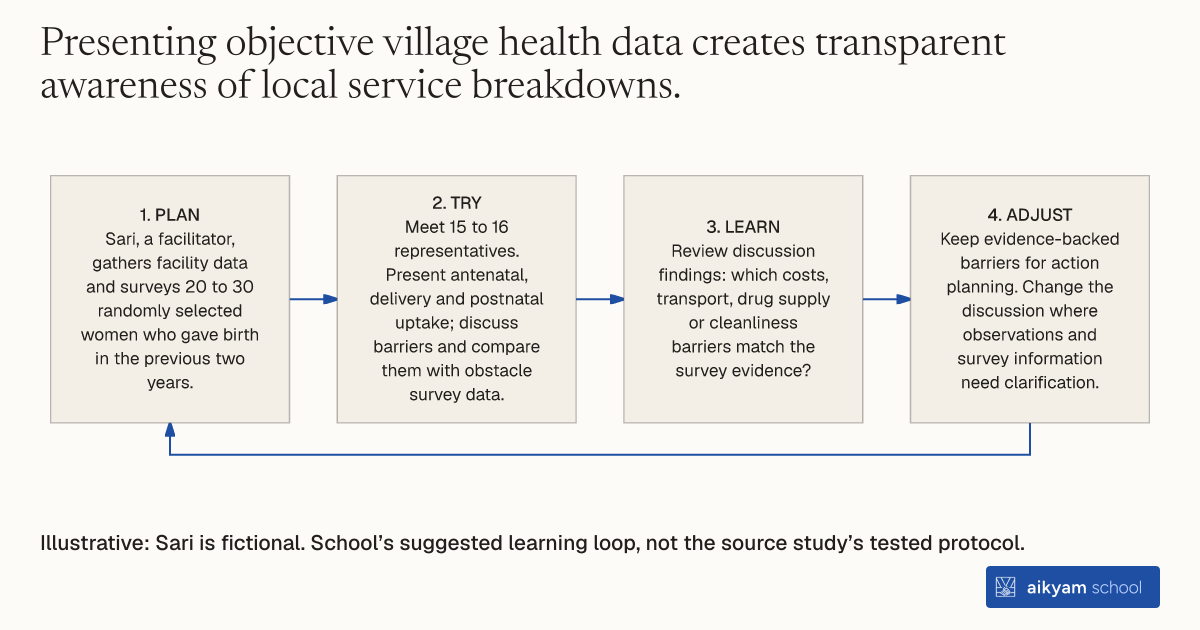
- Plan: Sari, a facilitator, gathers facility data and surveys 20 to 30 randomly selected women who gave birth in the previous two years.
- Try: Meet 15 to 16 representatives. Present antenatal, delivery and postnatal uptake; discuss barriers and compare them with obstacle survey data.
- Learn: Review discussion findings: which costs, transport, drug supply or cleanliness barriers match the survey evidence?
- Adjust: Keep evidence-backed barriers for action planning. Change the discussion where observations and survey information need clarification.
Illustrative: Sari is fictional. School’s suggested learning loop, not the source study’s tested protocol.
See source →School's suggested, untested loop: observe scorecard data and identified barriers; the meeting alone does not establish better health services.
How
When to use
Rural communities face low uptake and poor quality of maternal and newborn health services. Program leaders need a structured diagnostic meeting to present village health metrics and engage local residents in identifying service breakdowns. Facilitators run this method to help citizens uncover specific local barriers before designing social actions.
Conduct a community scorecard meeting to present local health data and identify maternal health barriers.
- Collect village-specific baseline health data from the local health facility and 20 to 30 randomly selected women who gave birth in the previous two years.
- Convene a local facilitator and 15 to 16 recruited community representatives in a dedicated village meeting space.
- Present scorecard indicators on community uptake across three key health levers: antenatal care, facility delivery, and postnatal care.
- Facilitate a structured discussion where community representatives examine the scorecard findings and identify local barriers to service utilization.
- Present survey data on specific obstacles, including service costs, drug availability, transportation options, and facility cleanliness, to validate participant observations.
Why it works
Guided group discussion allows citizens to connect statistical health gaps to their own lived experiences and identify solvable community problems.
Example
In 200 rural treatment villages across Indonesia and Tanzania, civil society facilitators held scorecard meetings with 15 to 16 community representatives per village using local survey data from health facilities and 20 to 30 mothers. These scorecard meetings led participants across 99.5% of communities to design targeted social action plans addressing the identified barriers.
About the study
Participants
200 rural villages across two regions in Indonesia and two regions in Tanzania, involving 15 to 16 community representatives per village and survey data from 20 to 30 recent mothers per village.
Study Design
Randomized controlled trial evaluation of a non-prescriptive social accountability intervention, using village health facility audits and maternal survey data to generate baseline scorecards for facilitated diagnostic community meetings.
Results
Scorecard meetings prompted 1,139 social actions across 200 villages, with participants in 99.5% of villages identifying demand-side health barriers and 71.0% addressing facility access barriers.