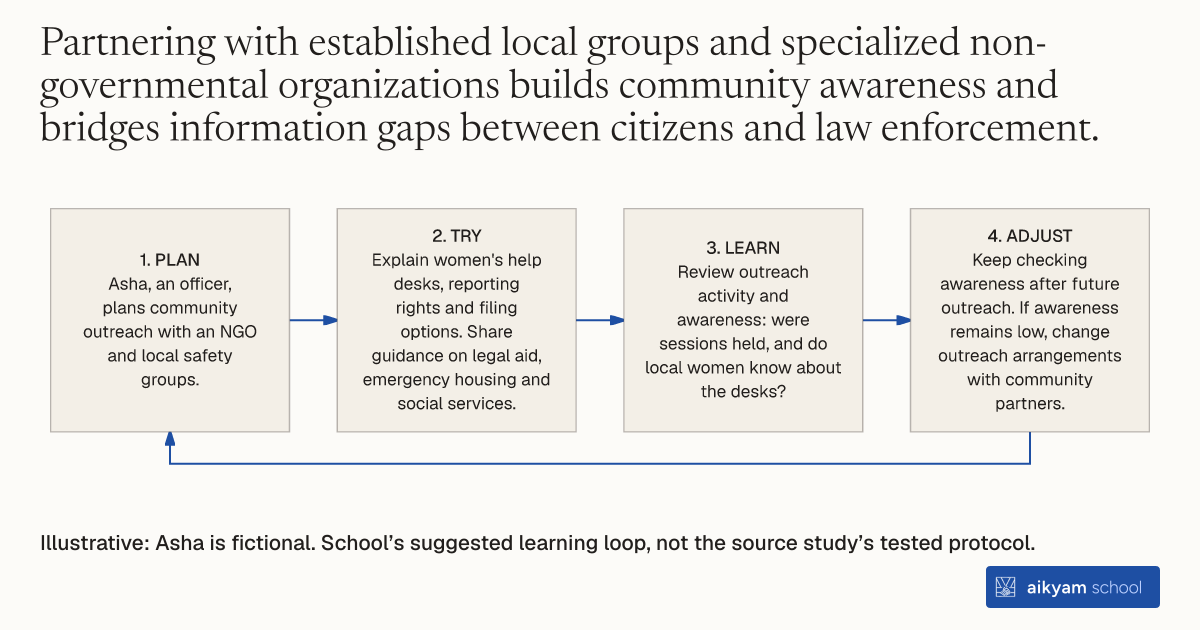
Try, learn and adjust
Check outreach explains help desk services
- Plan: Asha, an officer, plans community outreach with an NGO and local safety groups.
- Try: Explain women's help desks, reporting rights and filing options. Share guidance on legal aid, emergency housing and social services.
- Learn: Review outreach activity and awareness: were sessions held, and do local women know about the desks?
- Adjust: Keep checking awareness after future outreach. If awareness remains low, change outreach arrangements with community partners.
Illustrative: Asha is fictional. School’s suggested learning loop, not the source study’s tested protocol.
See source →School's suggested, untested loop: observe outreach delivery and help desk awareness; an event alone does not establish wider awareness.
How
When to use
Many female victims of gender-based violence do not report crimes due to low awareness of specialized police help services and pervasive stigma around law enforcement. Isolated police stations struggle to inform local women about new institutional support systems on their own. This method connects police stations with community safety networks and local non-governmental organizations to inform women about dedicated help desks and civil support resources.
Conduct joint community outreach events with local civil society groups to inform female citizens about police help desks.
- Police station officers partner with specialized non-governmental organizations like ActionAid and local community safety networks.
- Station personnel and non-governmental organization representatives organize public community outreach sessions within police station catchment areas.
- Event leaders present information on women's help desk services, reporting rights, and filing options for gender-based violence.
- Facilitators distribute resource guidance detailing legal assistance, emergency housing, and social services for survivors.
Why it works
Direct outreach sessions inform women of their legal rights and available police support, reducing hesitation to access justice.
Example
In Madhya Pradesh, India, police and ActionAid conducted community outreach events across 87 percent of treatment police station areas in 12 districts, though large catchment sizes limited total citizen awareness to 10 percent.
About the study
Participants
180 police stations across 12 districts in Madhya Pradesh, India, serving average catchment populations of 130,000 citizens.
Study Design
Randomized controlled trial comparing 61 regular help desk stations, 59 woman-run help desk stations, and 60 control stations evaluated from May 2019 to October 2020.
Results
87 percent of treatment stations conducted at least one community outreach event, but overall citizen awareness of help desks remained low at 10 percent, with no significant increase in general women's station visits.