Try, learn and adjust
Check filing training reaches station practice
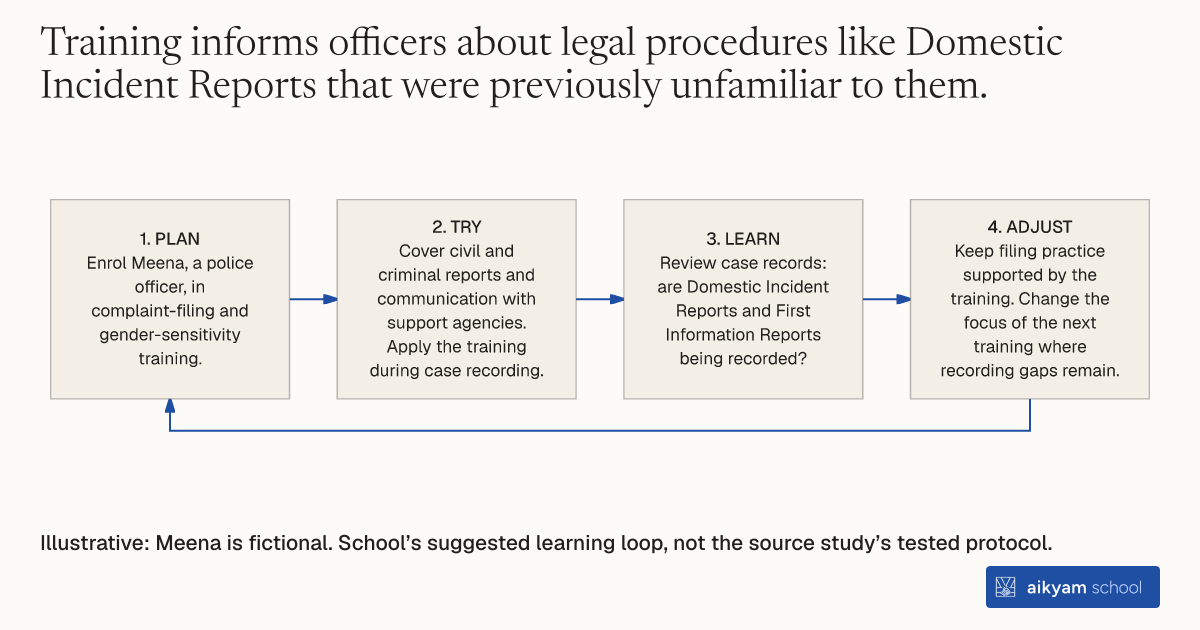
- Plan: Enrol Meena, a police officer, in complaint-filing and gender-sensitivity training.
- Try: Cover civil and criminal reports and communication with support agencies. Apply the training during case recording.
- Learn: Review case records: are Domestic Incident Reports and First Information Reports being recorded?
- Adjust: Keep filing practice supported by the training. Change the focus of the next training where recording gaps remain.
Illustrative: Meena is fictional. School’s suggested learning loop, not the source study’s tested protocol.
See source →School’s suggested, untested loop. Observe report registration and respectful treatment. Help desks and training were evaluated together; this check does not isolate training effects.
How
When to use
Police officers frequently resist recording cases of gender-based violence due to a lack of legal knowledge and training on procedures like Domestic Incident Reports. Capacity constraints and social norms also lead officers to dismiss complaints or avoid time-consuming filings. Conducting systematic training modules equips officers with legal knowledge and gender sensitivity to handle cases properly.
Train police officers on procedures for registering crimes against women and communicating with support agencies.
- Police department leaders organize training sessions for officers in participating stations.
- Trainers deliver modules covering the filing of First Information Reports and Domestic Incident Reports.
- Trainers instruct officers on communication protocols with state and civil society agencies.
- Trainers conduct gender sensitization modules to address officer bias regarding women's claims.
- Trained officers implement systematic case recording during daily station operations.
Why it works
It also increases officer awareness of policing shortcomings and makes female officers less likely to assume women file false complaints.
Example
The Madhya Pradesh Police Department trained officers across 120 police stations in India. Stations receiving training and help desks registered 1.5 Domestic Incident Reports per month compared to 0.05 in comparison stations, generating 1,905 additional civil filings.
About the study
Participants
180 police stations across 12 representative districts in Madhya Pradesh, India, serving average populations of 130,000 people per station.
Study Design
A randomized evaluation comparing 120 stations receiving training and help desks against 60 control stations without training or help desks.
Results
Trained help desk stations registered 1.5 Domestic Incident Reports per month compared to 0.05 in control stations, adding 1,905 civil filings. These stations also registered 14 percent more First Information Reports, averaging 4.4 per month compared to 3.8 in control stations, adding 3,360 criminal filings. Expressed levels of comfort and respectful treatment improved in stations with greater training quality.