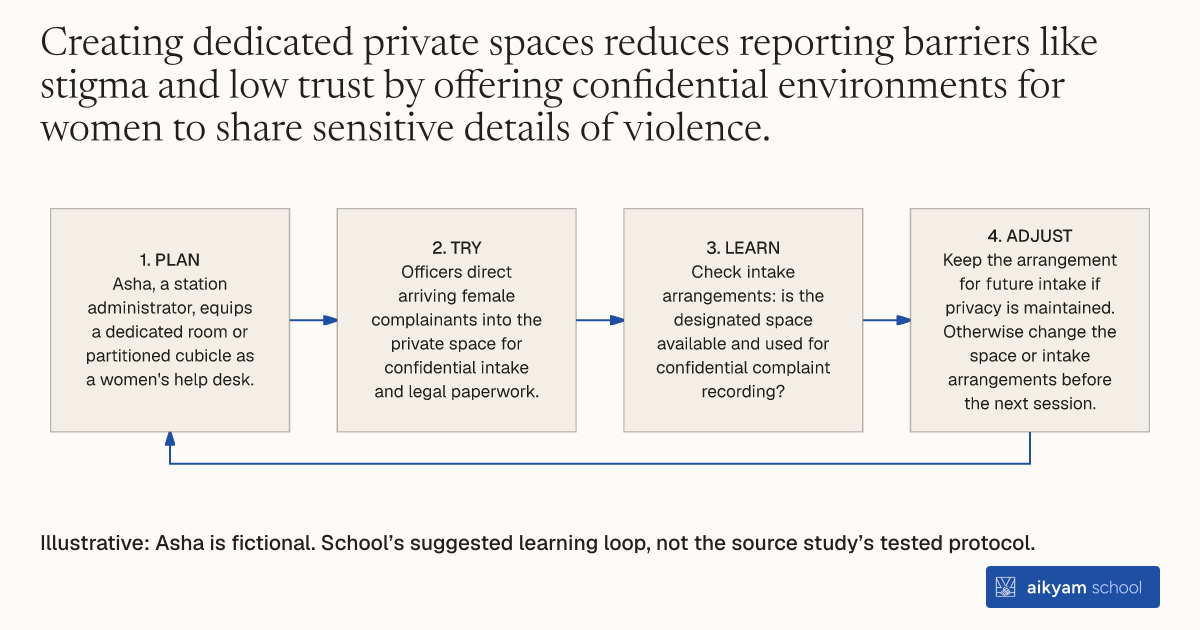
Try, learn and adjust
Check private complaint intake is available
- Plan: Asha, a station administrator, equips a dedicated room or partitioned cubicle as a women's help desk.
- Try: Officers direct arriving female complainants into the private space for confidential intake and legal paperwork.
- Learn: Check intake arrangements: is the designated space available and used for confidential complaint recording?
- Adjust: Keep the arrangement for future intake if privacy is maintained. Otherwise change the space or intake arrangements before the next session.
Illustrative: Asha is fictional. School’s suggested learning loop, not the source study’s tested protocol.
See source →School's suggested, untested loop: observe private space and confidential intake; this check does not establish effects on crime reporting.
How
When to use
Female victims of gender-based violence often hesitate to report crimes to law enforcement due to social stigma and low trust in police. Standard police station lobbies lack privacy, exposing women to public scrutiny when discussing sensitive incidents. This method provides a dedicated private space within existing stations for women seeking assistance and reporting crimes safely.
Establish designated private intake spaces inside police stations to provide confidential environments for female complainants.
- Police station administrators allocate a dedicated room or partitioned cubicle inside each participating station for women seeking assistance.
- Station personnel equip the designated area with desk infrastructure to operate as a dedicated Women's Help Desk.
- Assigned officers direct female complainants into the private space immediately upon their arrival at the police station.
- Help desk officers conduct confidential intake sessions in this private space to record complaint details and initiate legal paperwork.
Why it works
It signals institutional responsiveness and prioritizes women's security concerns within general police station facilities.
Example
Madhya Pradesh Police established private help desk spaces across treatment stations in 12 districts in India, contributing to 1,905 additional Domestic Incident Reports and 3,360 additional First Information Reports registered during the study.
About the study
Participants
180 police stations across 12 districts in Madhya Pradesh, India, serving station catchment areas averaging 130,000 citizens.
Study Design
Randomized controlled trial comparing 61 regular help desk stations, 59 woman-run help desk stations, and 60 control stations from May 2019 to October 2020.
Results
Stations with help desks registered 1.5 Domestic Incident Reports per month compared to 0.05 in control stations, and registered 14 percent more First Information Reports for crimes against women.