Try, learn and adjust
Check support referrals match identified needs
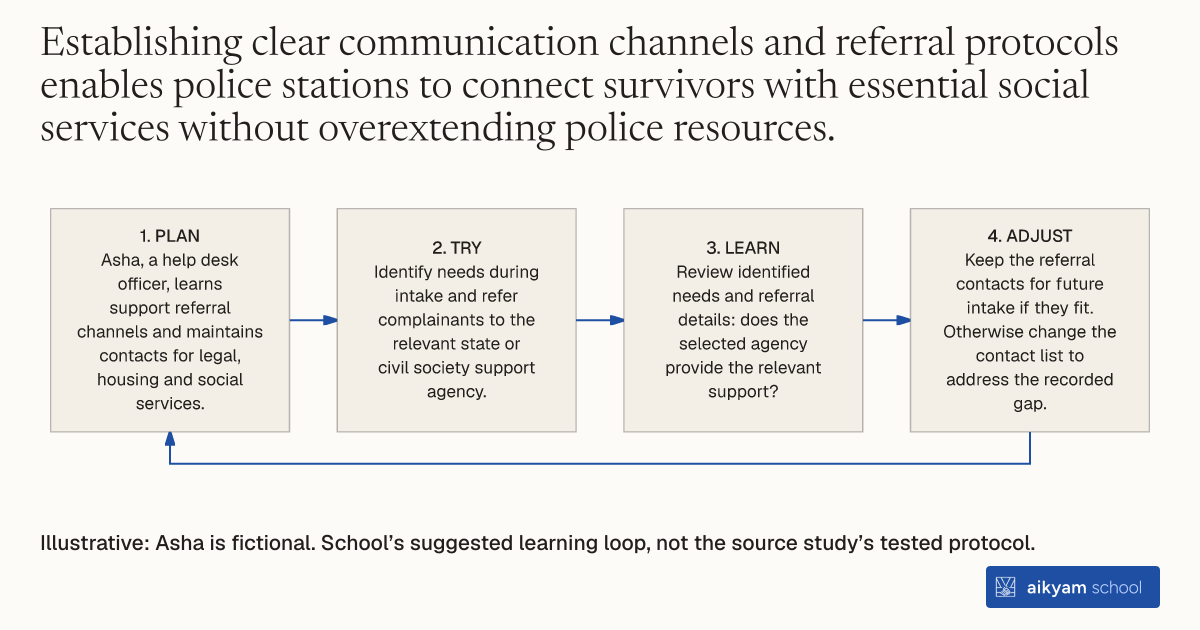
- Plan: Asha, a help desk officer, learns support referral channels and maintains contacts for legal, housing and social services.
- Try: Identify needs during intake and refer complainants to the relevant state or civil society support agency.
- Learn: Review identified needs and referral details: does the selected agency provide the relevant support?
- Adjust: Keep the referral contacts for future intake if they fit. Otherwise change the contact list to address the recorded gap.
Illustrative: Asha is fictional. School’s suggested learning loop, not the source study’s tested protocol.
See source →School's suggested, untested loop: observe identified needs, agency contacts and referral choices; a referral does not prove service receipt.
How
When to use
Female survivors of gender-based violence often require holistic support beyond criminal prosecution, including medical aid, legal assistance, emergency shelter, and social counseling. Police stations operating in isolation lack standardized procedures to connect survivors with non-police service providers. This method establishes formal referral networks and communication channels between police help desks and social service agencies.
Establish formal referral networks between police stations and social service agencies to connect survivors of gender-based violence with non-police assistance.
- Police administrators establish designated communication channels with state and civil society support agencies.
- Training facilitators instruct police officers on identifying victim needs during intake, including first aid, trauma support, housing, and legal aid.
- Help desk personnel maintain contact lists of external social service providers offering legal, housing, and social support.
- Station officers refer female complainants to relevant partner organizations based on individual victim needs identified during intake.
Why it works
It ensures victims receive comprehensive medical, legal, and housing assistance from specialized civil society providers.
Example
Madhya Pradesh Police integrated referral protocols into officer training across 120 help desk stations in 12 districts, establishing referral links with civil society organizations for legal assistance, housing, and social support.
About the study
Participants
180 police stations across 12 districts in Madhya Pradesh, India, serving average station catchment populations of 130,000 citizens.
Study Design
Randomized controlled trial comparing 61 regular help desk stations, 59 woman-run help desk stations, and 60 control stations evaluated from May 2019 to October 2020.
Results
Officers across 120 help desk stations received referral training, contributing to 1,905 additional Domestic Incident Reports filed alongside referrals to civil social service agencies.