Research procedure
Build a borrower trait index
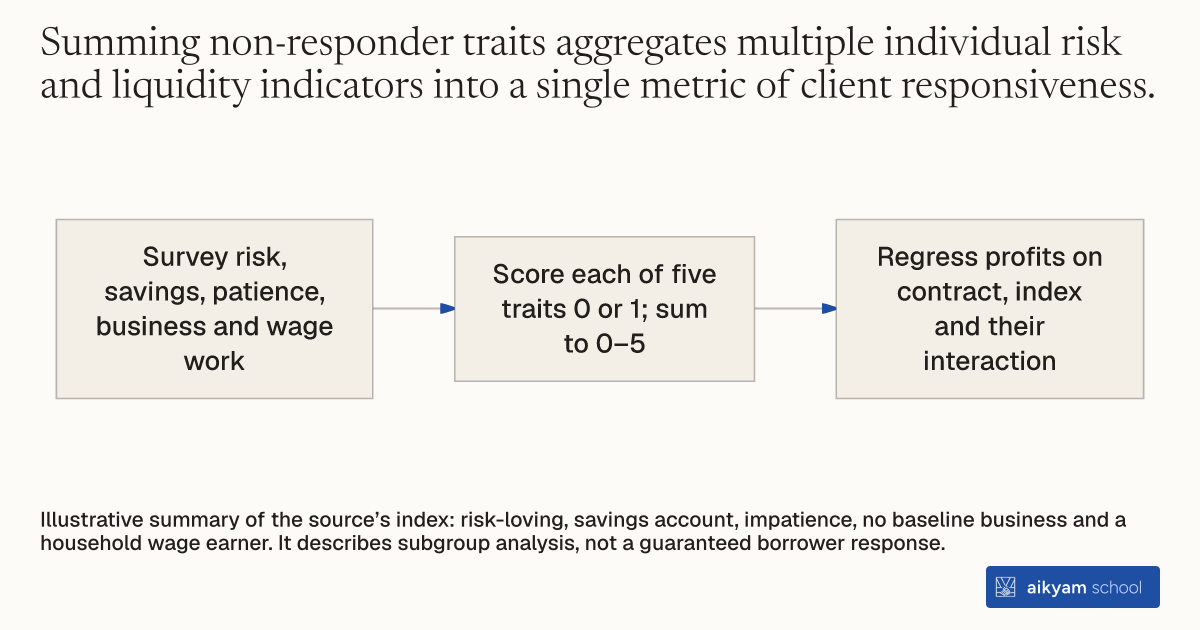
- Survey risk, savings, patience, business and wage work
- Score each of five traits 0 or 1; sum to 0–5
- Regress profits on contract, index and their interaction
Illustrative summary of the source’s index: risk-loving, savings account, impatience, no baseline business and a household wage earner. It describes subgroup analysis, not a guaranteed borrower response.
See source →How
When to use
Microfinance evaluators need to identify which borrowers profit most from flexible loan terms versus standard contracts. Program outcomes often mask substantial variations in client response across diverse demographic and behavioral subgroups. Constructing a composite index of non-responder traits allows researchers to isolate responsive borrower segments and predict program impacts.
Construct a composite heterogeneity index by summing individual client non-responder characteristics to evaluate subgroup treatment effects.
- Administer baseline surveys measuring client risk attitudes, formal savings ownership, time preferences, household wage employment, and business ownership.
- Define five specific non-responder traits: being risk-loving, possessing a savings account, being impatient, lacking a baseline business, and having a household wage earner.
- Assign a score of one for each non-responder trait a client possesses and zero otherwise.
- Sum the scores to create an integer index ranging from zero to five for each client.
- Regress long-run microenterprise profits on debt contract assignment, the heterogeneity index score, and their interaction term.
Why it works
Measuring interaction effects across index scores reveals how accumulation of constraint-reducing traits dampens the economic impact of flexible loan terms.
Example
Researchers evaluated long-run profit responsiveness among 752 microfinance clients in Kolkata using a five-trait non-responder index. The index showed that grace period contracts increased profits by 109.2 percent for clients with zero non-responder traits, 70.9 percent for clients with one trait, and 20.9 percent for clients with two traits.
About the study
Participants
752 female microfinance clients surveyed in Kolkata, India roughly three years post-disbursal.
Study Design
Interaction regression analysis evaluating 3-year weekly business profit treatment effects across scores on a 5-point non-responder characteristic index.
Results
Grace period contracts increased long-run business profits by 109.2 percent among 10 percent of clients with zero non-responder traits, 70.9 percent among 36 percent with one trait, and 20.9 percent among 35 percent with two traits, confirming significant treatment gains for 47 to 82 percent of borrowers.