Research steps
Adjust trial estimates with LASSO
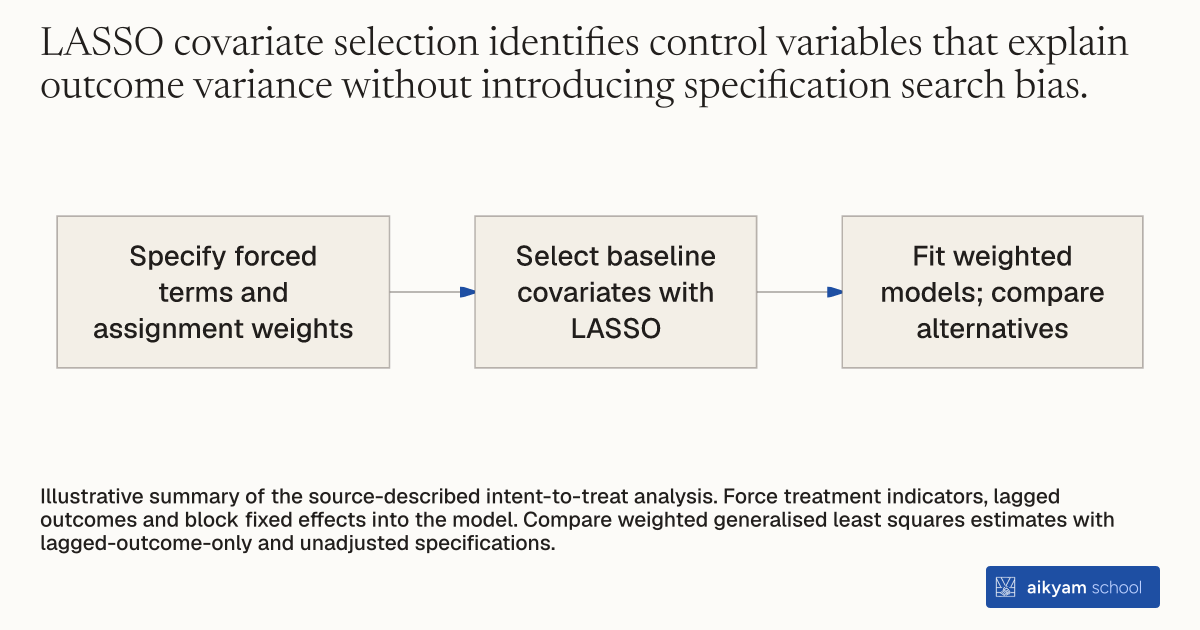
- Specify forced terms and assignment weights
- Select baseline covariates with LASSO
- Fit weighted models; compare alternatives
Illustrative summary of the source-described intent-to-treat analysis. Force treatment indicators, lagged outcomes and block fixed effects into the model. Compare weighted generalised least squares estimates with lagged-outcome-only and unadjusted specifications.
See source →How
When to use
Unadjusted treatment effect estimates in randomized trials often suffer from statistical noise and reduced precision. Selecting control variables manually risks selective reporting or data dredging. Machine learning variable selection provides an objective way for evaluators to choose baseline covariates that maximize statistical precision.
Estimate treatment effects in randomized field trials by combining weighted generalized least squares with machine-learning-selected baseline covariates.
- Specify an intent-to-treat regression model including treatment indicators, randomization block fixed effects, and inverse probability weights.
- Force treatment indicators, lagged dependent variables, and block fixed effects directly into the regression model.
- Apply a Least Absolute Shrinkage and Selection Operator (LASSO) algorithm to select predictive baseline covariates from the outcome family.
- Estimate treatment coefficients using weighted generalized least squares regressions incorporating the LASSO-selected covariates.
- Compare primary LASSO-adjusted estimates against secondary specifications controlling only for lagged dependent variables or omitting covariates entirely.
Why it works
Controlling for predictive baseline traits reduces residual variance and increases statistical precision when estimating program impacts.
Example
In Egypt, researchers estimated campaign treatment effects across 4,165 women using weighted regressions with LASSO-selected baseline covariates, achieving precise estimates for video consumption recall (0.86 to 1.03 SD) and resource knowledge (0.12 to 0.30 SD).
About the study
Participants
4,165 female internet users in Egypt who completed the endline survey across five experimental arms.
Study Design
Intent-to-treat ANCOVA estimation using Weighted Generalized Least Squares (WGLS) with inverse probability weights, block fixed effects, and LASSO-selected baseline covariates.
Results
LASSO-selected covariate models yielded precise treatment effect estimates across outcome indices, including a 1.026 SD increase in social media video consumption recall (p < 0.01) and a 0.225 SD increase in resource knowledge (p < 0.01).