Try, learn and adjust
Check conservation contracts cover the whole property
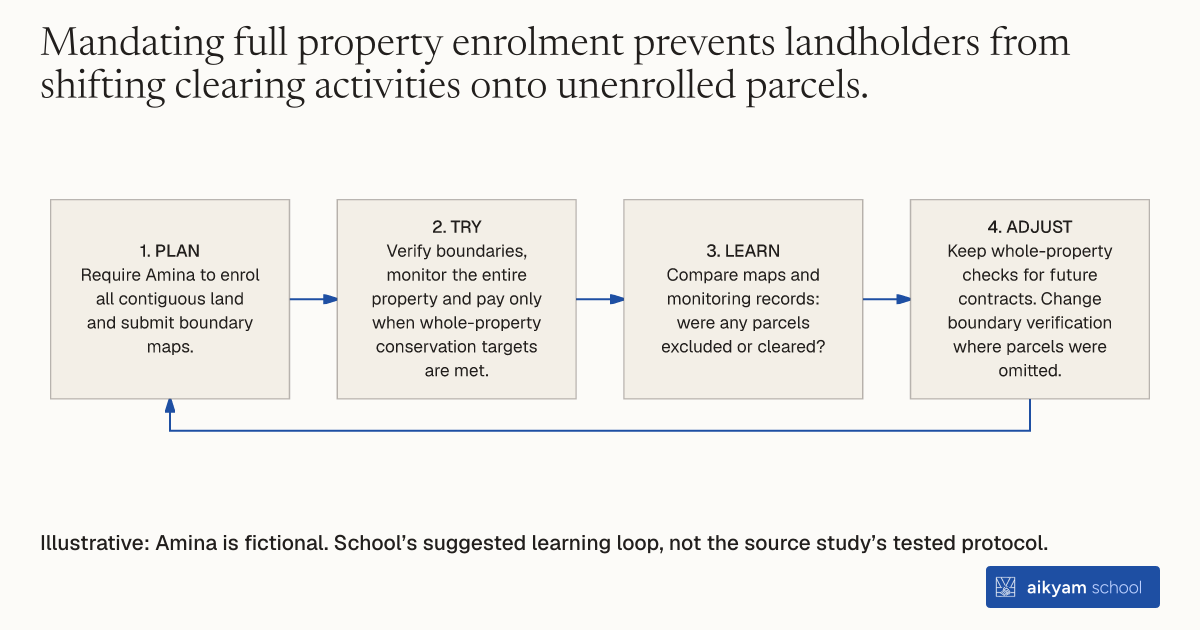
- Plan: Require Amina to enrol all contiguous land and submit boundary maps.
- Try: Verify boundaries, monitor the entire property and pay only when whole-property conservation targets are met.
- Learn: Compare maps and monitoring records: were any parcels excluded or cleared?
- Adjust: Keep whole-property checks for future contracts. Change boundary verification where parcels were omitted.
Illustrative: Amina is fictional. School’s suggested learning loop, not the source study’s tested protocol.
See source →School’s suggested, untested loop. Observe boundaries, enrolment and clearing across the whole property; do not infer a new deforestation effect.
How
When to use
Standard conservation programs allow landholders to choose which land parcels to enroll. Participants often collect payments on enrolled land while clearing trees on unenrolled parcels. Requiring whole-property enrolment solves this clearing loophole for program managers.
Require landholders to enroll all contiguous land into conservation contracts rather than selecting individual parcels.
- Draft conservation contracts that mandate full property enrolment.
- Require applicants to submit legal boundary maps of their total landholdings.
- Verify property boundaries to ensure participants exclude no parcels.
- Monitor the entire property for land clearing throughout the contract period.
- Disburse cash transfers only when the whole property meets conservation targets.
Why it works
Participants maintain high enrolment rates because payments still offer attractive financial returns.
Example
Researchers in Mexico tested whole-property contracts against partial-parcel contracts, finding that whole-property enrolment reduced deforestation by 41 percent.
About the study
Participants
Human private landholders participating in a pilot PES program in Mexico.
Study Design
Randomized Controlled Trial comparing whole-property enrolment contracts to standard partial-parcel contracts.
Results
Requiring participants to enroll all land cut deforestation by 41 percent and made the program nearly five times more cost-effective than standard policy.