Research survey
Compare employee survey responses over time
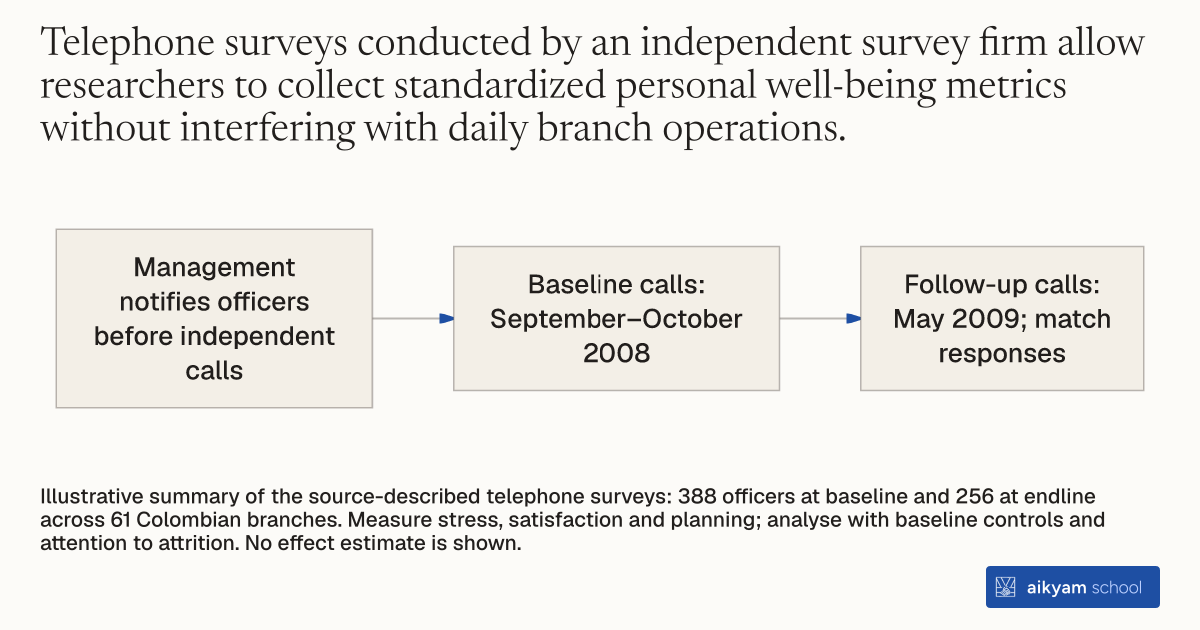
- Management notifies officers before independent calls
- Baseline calls: September–October 2008
- Follow-up calls: May 2009; match responses
Illustrative summary of the source-described telephone surveys: 388 officers at baseline and 256 at endline across 61 Colombian branches. Measure stress, satisfaction and planning; analyse with baseline controls and attention to attrition. No effect estimate is shown.
See source →How
When to use
Evaluating non-financial program outcomes like stress, job satisfaction, and planning behavior among frontline employees requires gathering subjective, person-specific metrics that internal IT systems do not track. Conducting telephone surveys at baseline and endline allows evaluators to measure changes in employee well-being across treatment and control groups. This method serves researchers and managers assessing workplace interventions.
Administer structured telephone surveys before and after an organizational intervention to evaluate individual employee well-being, stress levels, and work habits.
- Bank management contacts loan officers in advance to notify them that a research survey will be conducted over the phone.
- Professional survey firm enumerators place calls to all 388 baseline loan officers in September and October 2008 prior to program implementation.
- Survey enumerators record demographic characteristics, baseline stress levels, job satisfaction scale ratings, satisfaction with compensation, and self-reported work-planning practices.
- Professional survey firm enumerators conduct follow-up telephone survey calls in May 2009 at the conclusion of the six-month intervention.
- Analysts match individual baseline and endline responses to run difference-in-differences probit and OLS regressions controlling for baseline satisfaction levels and attrition.
Why it works
Pre-notifying employees through management maintains high response rates and ensures reliable longitudinal data collection.
Example
In Colombia, an independent survey firm conducted telephone baseline surveys with 388 loan officers in September 2008 and endline surveys with 256 remaining loan officers in May 2009 for Bancamía. The surveys achieved a 98 percent baseline response rate and a 96 percent endline response rate, enabling researchers to measure a 5.8 percentage point reduction in work stress and a 5 percentage point increase in job satisfaction among treatment loan officers.
About the study
Participants
388 loan officers at baseline (47% female, mean age 29.4 years, average 15 years education) and 256 loan officers at endline across 61 bank branches in Colombia.
Study Design
Panel survey design with telephone interviews conducted by a professional survey firm pre-intervention (Sept–Oct 2008) and post-intervention (May 2009), analyzed using probit, ordered probit, and OLS difference-in-differences regressions with branch-clustered standard errors.
Results
The survey achieved a 98% response rate at baseline and 96% at endline; data revealed that treatment loan officers were 8 percentage points more likely to increase or maintain high planning levels (p < 0.10), experienced a 5.8 percentage point reduction in time feeling stressed (p < 0.10), and showed a 5 percentage point increase in work satisfaction (p < 0.10).