Research procedure
Measure sleep with wrist monitors
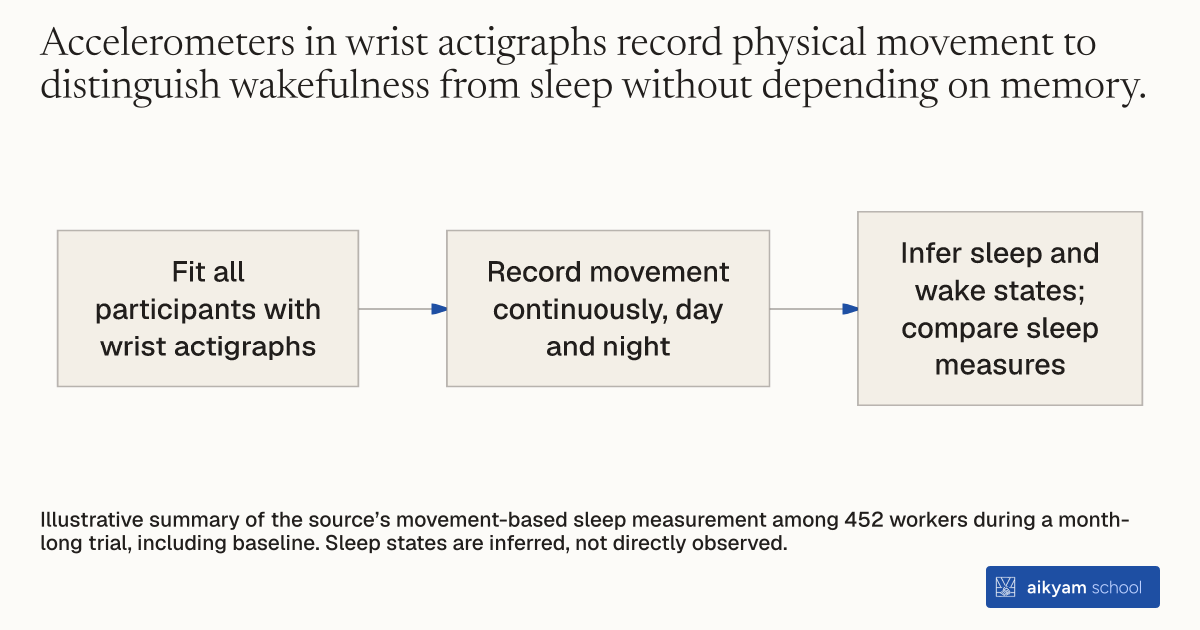
- Fit all participants with wrist actigraphs
- Record movement continuously, day and night
- Infer sleep and wake states; compare sleep measures
Illustrative summary of the source’s movement-based sleep measurement among 452 workers during a month-long trial, including baseline. Sleep states are inferred, not directly observed.
See source →How
When to use
Self-reported sleep measures are often unreliable or prone to recall bias in field research. Continuously tracking body movements using wearable wristbands provides precise and objective sleep data in real-world settings. This method serves evaluators and researchers who need accurate data on sleep duration and sleep efficiency.
Equip participants with wrist actigraph monitors to capture continuous objective data on sleep and wake cycles.
- Provide wrist actigraph devices to all study participants at the start of the study.
- Instruct participants to wear the wrist actigraph continuously day and night throughout the study period.
- Infer sleep and wake states continuously based on body movements recorded by the device.
- Calculate baseline sleep parameters including daily total sleep time and sleep efficiency.
- Track changes in nighttime sleep duration and daytime nap quality across intervention groups.
Why it works
Objective tracking eliminates reporting bias and detects subtle sleep disruptions that self-reports miss.
Example
Researchers equipped 452 low-income urban workers in Chennai, India, with wrist actigraphs worn continuously to track sleep duration and efficiency across a one-month trial.
About the study
Participants
452 men and women from low-income neighborhoods in Chennai, India, with an average of 10 years of education.
Study Design
A randomized evaluation collecting continuous objective sleep state data via wrist actigraphs during a baseline period and throughout a month-long trial.
Results
Actigraphy revealed participants spent 8 hours per night in bed but slept for only 5.6 hours (66 percent sleep efficiency), while workplace naps achieved 85 percent sleep efficiency.