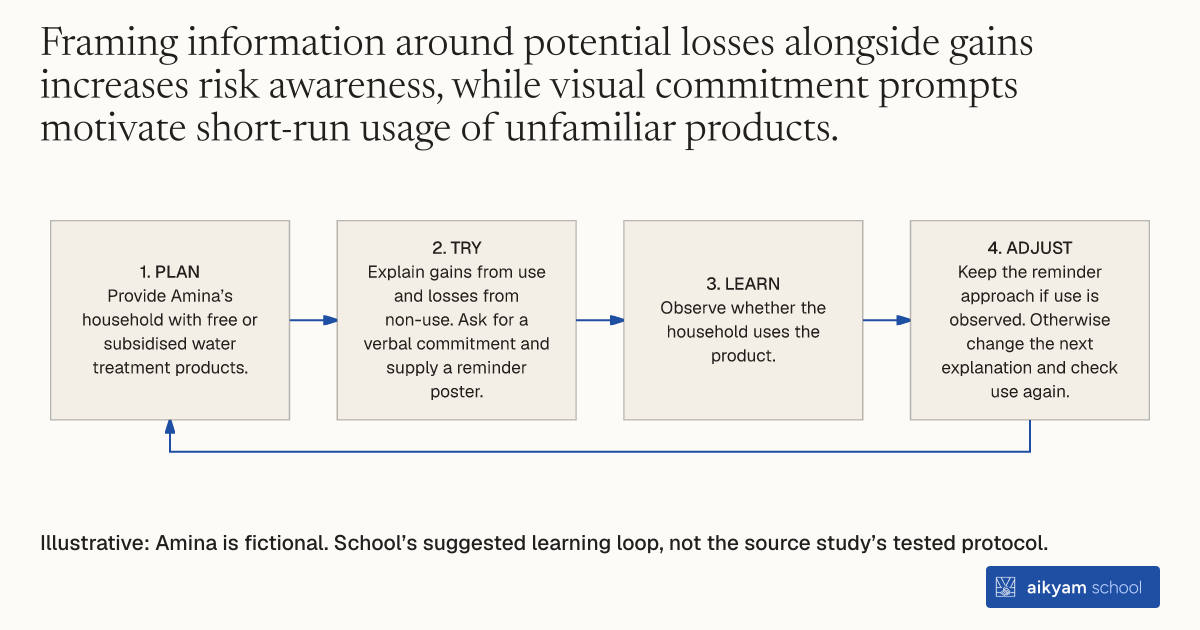
Try, learn and adjust
Check use after a water treatment reminder
- Plan: Provide Amina’s household with free or subsidised water treatment products.
- Try: Explain gains from use and losses from non-use. Ask for a verbal commitment and supply a reminder poster.
- Learn: Observe whether the household uses the product.
- Adjust: Keep the reminder approach if use is observed. Otherwise change the next explanation and check use again.
Illustrative: Amina is fictional. School’s suggested learning loop, not the source study’s tested protocol.
See source →School’s suggested learning loop, not the source’s tested procedure. Observe product use. The source compares combined framing and reminders with traditional messaging, not each component alone.
How
When to use
Many households in low- and middle-income countries do not consistently use point-of-use water treatment products even when offered for free. Simple information messages often fail to motivate behavior change or long-term habit adoption. Combining behavioral nudges like contrast framing and commitment prompts helps motivate households to adopt water treatment practices.
Provide behavioral nudges alongside free or subsidized water treatment products to encourage household product adoption.
- Provide targeted households with free or subsidized point-of-use water treatment products.
- Deliver information about the health benefits of water treatment using a contrast frame that highlights losses from non-use alongside gains from use.
- Ask household members to make a verbal commitment to use the water treatment product.
- Distribute a reminder poster to households to display in their home as a visual prompt for their commitment.
Example
In rural Kenya and urban slums in Bangladesh, combining contrast framing with commitment posters increased observed usage rates of free point-of-use water treatment products by 7 percentage points in Kenya and 4 percentage points in Bangladesh compared to traditional messaging.