Try, learn and adjust
Check protected spring water quality
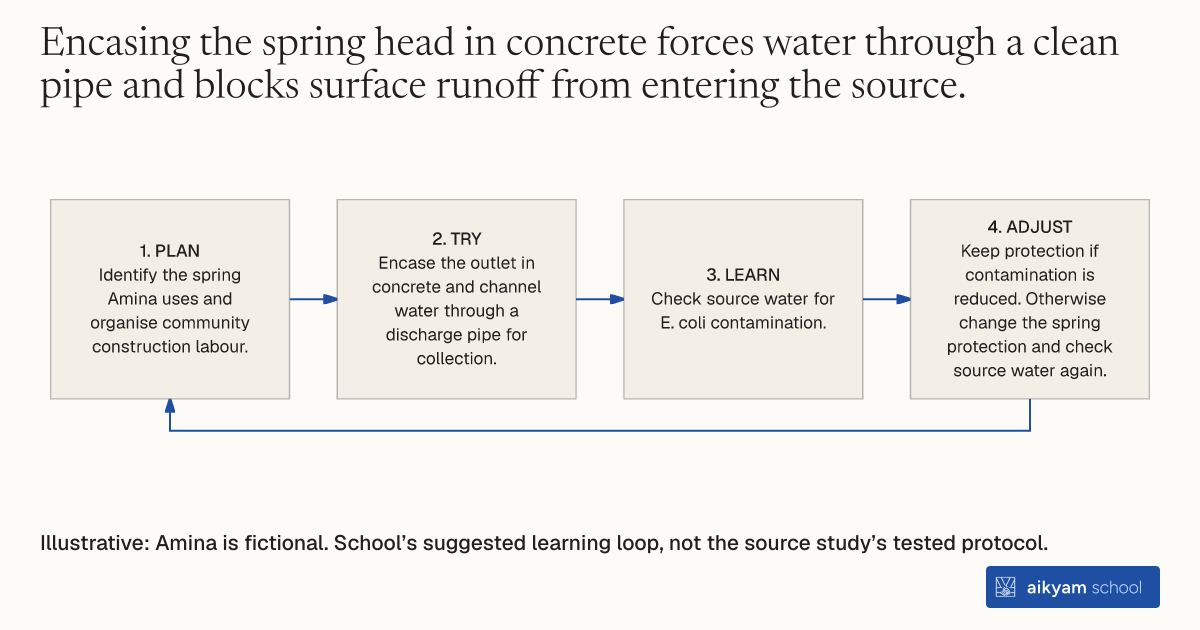
- Plan: Identify the spring Amina uses and organise community construction labour.
- Try: Encase the outlet in concrete and channel water through a discharge pipe for collection.
- Learn: Check source water for E. coli contamination.
- Adjust: Keep protection if contamination is reduced. Otherwise change the spring protection and check source water again.
Illustrative: Amina is fictional. School’s suggested learning loop, not the source study’s tested protocol.
See source →School’s suggested learning loop, not the source’s tested procedure. Observe E. coli at the source. This check alone does not establish reduced illness.
How
When to use
Many communities in low- and middle-income countries collect drinking water from unprotected natural springs. Groundwater runoff contaminates these water sources with harmful pathogens and bacteria. Encasing springs protects source water for populations living close to water collection points.
Protect water sources by encasing natural springs in concrete structures.
- Identify natural springs used by local community members for drinking water extraction.
- Mobilize local community members to provide labor inputs for construction.
- Encase the spring outlet in a concrete structure.
- Channel the spring outflow directly through a discharge pipe to prevent groundwater mixing.
- Direct community members to collect water directly from the pipe output.
Why it works
This prevents groundwater contaminants and environmental pathogens from polluting the collection point.
Example
In Western Kenya, a local non-governmental organization collaborated with local community members to encase springs in concrete. The intervention reduced E. coli contamination at the source by 66 percent and decreased self-reported diarrheal incidence among children under three years old by 4.7 percentage points, averting approximately 300 diarrheal incidents per 1,000 US dollars spent.