Research procedure
Retain meters on comparison pumps
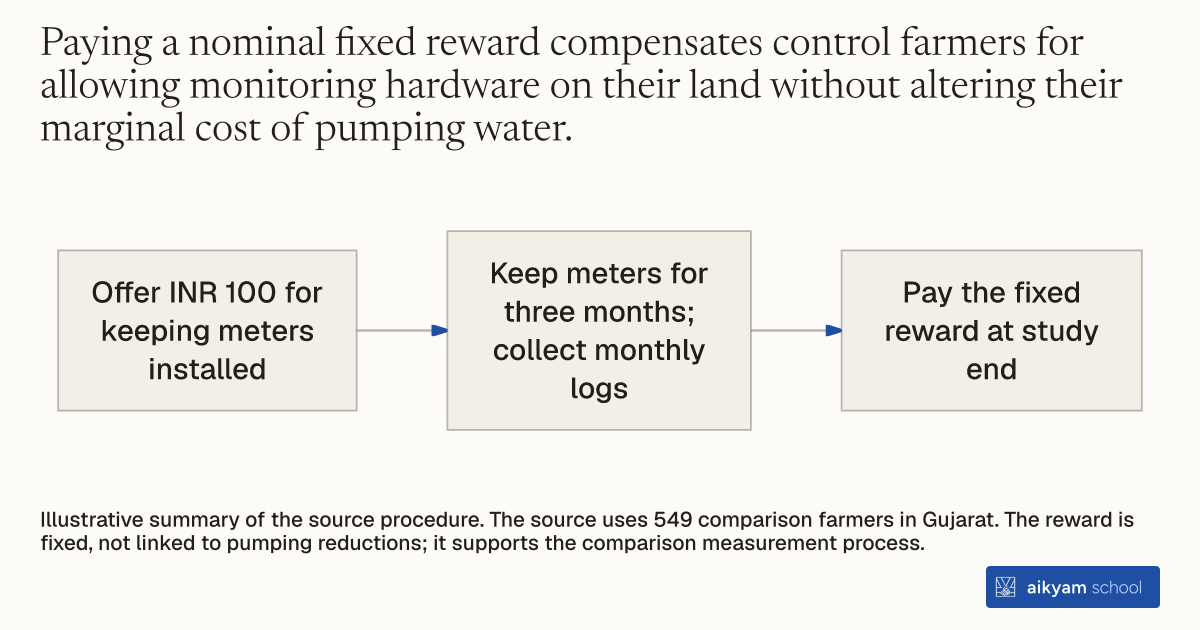
- Offer INR 100 for keeping meters installed
- Keep meters for three months; collect monthly logs
- Pay the fixed reward at study end
Illustrative summary of the source procedure. The source uses 549 comparison farmers in Gujarat. The reward is fixed, not linked to pumping reductions; it supports the comparison measurement process.
See source →How
When to use
Field experiments tracking resource usage face high attrition if un-incentivized control participants uninstall monitoring hardware. Program evaluators need to keep monitoring equipment active on non-treated farms to maintain a valid comparison baseline. Offering a small fixed reward to control participants encourages them to keep tracking equipment installed for the full study duration.
Provide a fixed monetary reward to non-treated comparison participants for keeping monitoring devices installed on their equipment.
- Inform selected comparison participants that they were not chosen for the primary payment intervention program.
- Offer comparison participants a fixed financial reward of INR 100 to keep monitoring meters installed on their electric pump starters.
- Maintain hours-of-use meters on control pump starters throughout the entire three-month study period.
- Collect monthly pumping logs from comparison starter meters alongside intervention groups.
- Distribute the fixed retention reward to comparison participants at the end of the study duration.
Why it works
This prevents selective equipment removal and ensures reliable comparison data across the evaluation period.
Example
Researchers in Saurashtra, Gujarat, assigned 549 farmers to a comparison group. They informed these farmers that they were not selected for conservation payments and offered them INR 100 to keep starter meters installed for the duration of the study, enabling accurate monthly pumping comparisons against intervention groups.
About the study
Participants
549 smallholder comparison farmers in Saurashtra, Gujarat, India (part of 1,111 participating farmers evaluated).
Study Design
Randomized evaluation retaining starter hours-of-use meters on comparison pumps with a fixed INR 100 retention reward, monitored monthly from December 2022 to March 2023.
Results
Comparison group farmers pumped an average of 611 kilowatt-hours of electricity per month, serving as the baseline against which the 140 kilowatt-hour per month (23 percent) reduction in treatment groups was measured.