Research design
Compare insurance with expected-value cash
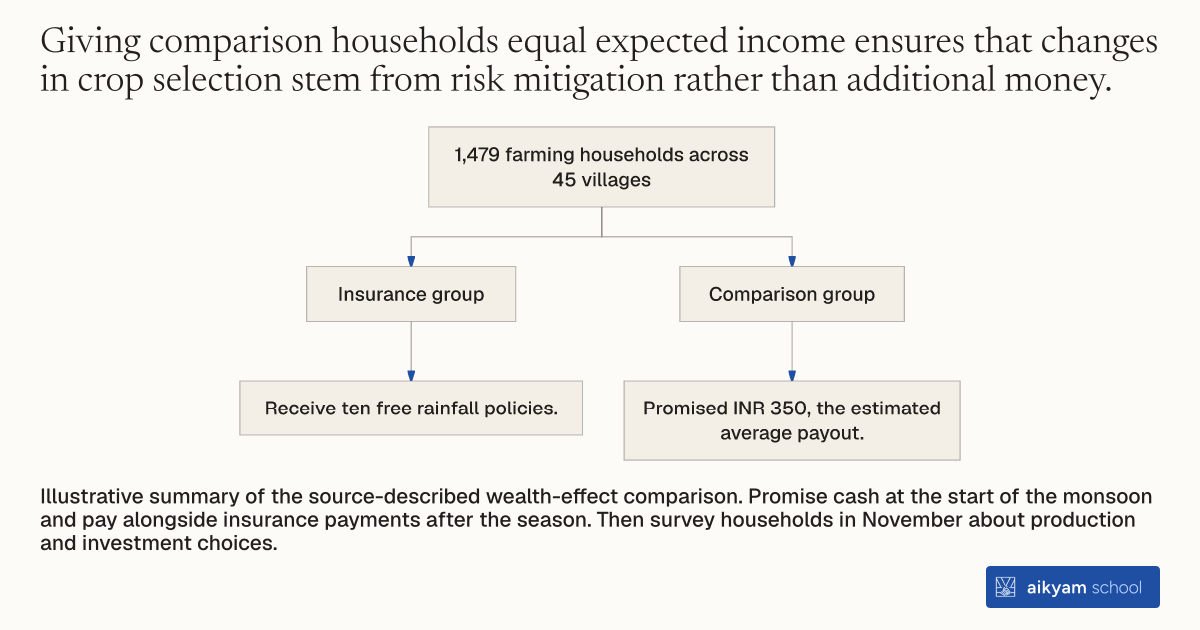
1,479 farming households across 45 villages
- Insurance group
- Receive ten free rainfall policies.
- Comparison group
- Promised INR 350, the estimated average payout.
Illustrative summary of the source-described wealth-effect comparison. Promise cash at the start of the monsoon and pay alongside insurance payments after the season. Then survey households in November about production and investment choices.
See source →How
When to use
Distributing free financial assets like insurance policies creates a wealth effect that distorts evaluation of the risk protection mechanism. Promise comparison households an unconditioned cash payout equal to the expected value of the policies to isolate risk reduction from income gains. Apply this method when conducting field experiments that evaluate free financial or insurance asset transfers among smallholder farmers.
Promise a fixed post-harvest cash payout equal to the expected average payout of free financial products to comparison participants to isolate risk coverage from wealth gains.
- Calculate the estimated average financial payout of the insurance policies distributed to the treatment group.
- Designate comparison households across the evaluation villages to receive an equivalent fixed transfer.
- Inform comparison households at the start of the monsoon season that they will receive the fixed cash transfer after the season.
- Set the payment amount to INR 350 per comparison household to match the expected average insurance payout.
- Disburse the fixed payments following the monsoon season alongside any insurance claim disbursements.
- Survey all households in November to evaluate production and investment choices under equal wealth expectations.
Why it works
This isolates the risk protection mechanism from general wealth expansion.
Example
Researchers in Andhra Pradesh, India, promised control group households a fixed payment of INR 350 (US\$7.78) following the monsoon season to mirror the estimated average payout of ten free rainfall insurance policies provided to treatment households.
About the study
Participants
1,479 small farming households across 45 villages in Andhra Pradesh, India; average household size 5.35 members, household head average age 49.6 years (91% male, 54% with no formal schooling).
Study Design
Randomized Controlled Trial (RCT) where comparison households were promised a fixed payout of INR 350 to hold wealth effects constant across treatment and comparison groups.
Results
Isolating the wealth effect confirmed that insurance coverage alone increased cash crop adoption by 6 percentage points (12 percent increase) and increased cash crop land allocation by 0.5 acres (27 percent increase).