Research design
Match expected value, distinguish risk cover
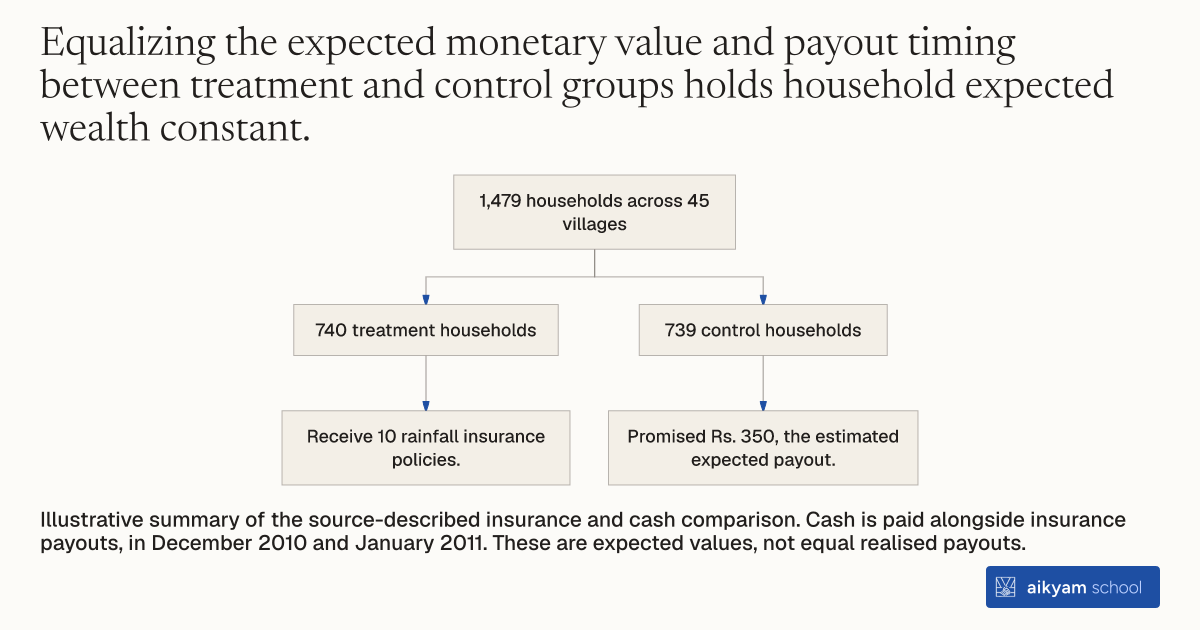
1,479 households across 45 villages
- 740 treatment households
- Receive 10 rainfall insurance policies.
- 739 control households
- Promised Rs. 350, the estimated expected payout.
Illustrative summary of the source-described insurance and cash comparison. Cash is paid alongside insurance payouts, in December 2010 and January 2011. These are expected values, not equal realised payouts.
See source →How
When to use
An evaluator seeks to isolate the state-contingent risk-mitigation effect of an asset or policy from the direct wealth effect created by providing it for free. Simply providing valuable financial assets to a treatment group increases their total wealth, making it difficult to determine whether behavioral changes stem from reduced risk exposure or increased net assets. Program managers promise control participants a future cash transfer equal to the expected actuarial value of the treatment asset to ensure both groups receive equivalent expected wealth.
Promise control group participants a fixed cash payment equal to the actuarial expected value of the treatment asset, synchronized to deliver payouts at the exact time insurance claims are settled.
- Estimate the actuarial expected payout value of the free treatment insurance policy package based on historical data.
- Visit control group households at the start of the monsoon season in June alongside treatment visits.
- Inform control households that they are assigned to receive a guaranteed future cash payment equal to the estimated expected value of the insurance policies.
- Schedule the control group cash disbursement to coincide precisely with the delivery of state-contingent insurance payouts.
- Disburse the fixed cash payments to control households after the growing season concludes.
Why it works
Any observed differences in subsequent production decisions can be attributed solely to the state-contingent risk-hedging mechanism of insurance rather than a pure income or wealth effect.
Example
ICRISAT enumerators promised 739 control group farming households across 45 villages in Mahbubnagar and Anantapur, Andhra Pradesh, India, a fixed cash payment of Rs. 350 (the estimated actuarial expected value of 10 ICICI Lombard rainfall insurance policies) in June 2009. The cash payments were disbursed in December 2010 and January 2011 alongside insurance payouts. Holding wealth constant showed that insurance provision specifically drove cash crop input expenditures up by 0.800 log points (p = 0.039) relative to the cash-compensated control group.
About the study
Participants
1,479 smallholder farming households across 45 villages in Mahbubnagar and Anantapur, Andhra Pradesh, India (739 control households receiving Rs. 350 cash promises, 740 treatment households receiving 10 insurance policies); 54% unschooled, average landholding 5.37 acres.
Study Design
Randomized Controlled Trial comparing input allocation and land use between households receiving state-contingent weather insurance and control households promised an equal expected cash value of Rs. 350.
Results
Control households receiving the Rs. 350 cash promise invested 48% of land in cash crops, compared to a 6 percentage point higher probability of cash crop planting among insurance recipients (p = 0.041), confirming that risk reduction, not wealth transfer, drove production shifts.