Research procedure
Delay control listeners’ access to drama
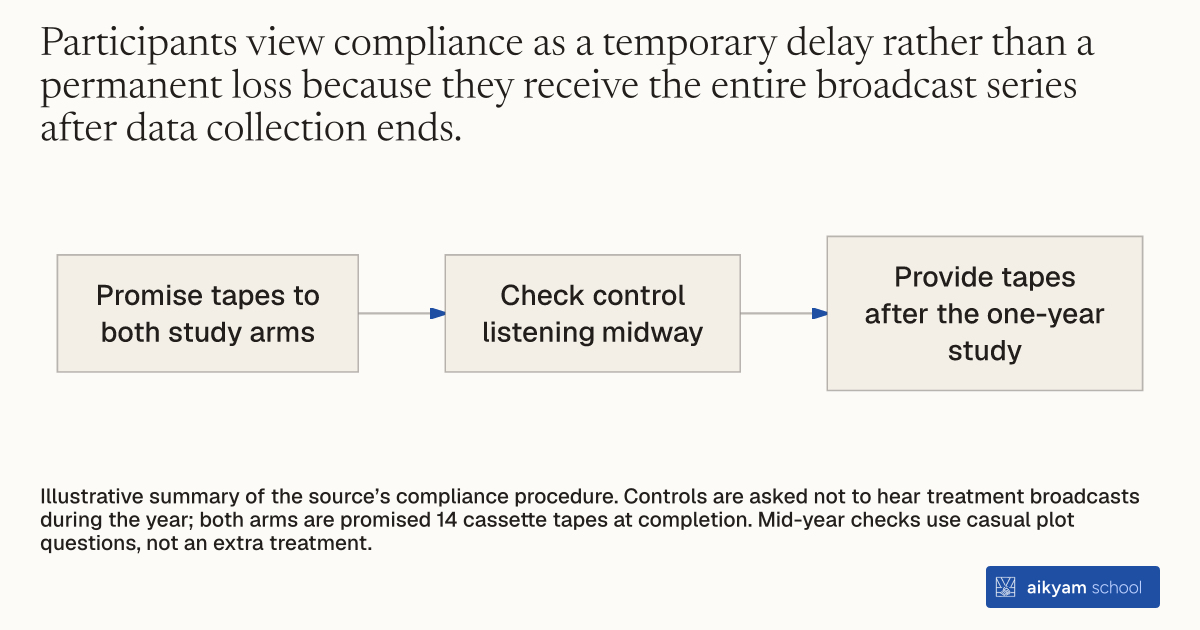
- Promise tapes to both study arms
- Check control listening midway
- Provide tapes after the one-year study
Illustrative summary of the source’s compliance procedure. Controls are asked not to hear treatment broadcasts during the year; both arms are promised 14 cassette tapes at completion. Mid-year checks use casual plot questions, not an extra treatment.
See source →How
When to use
Field experiments testing mass media interventions risk contamination when comparison group members listen to treatment broadcasts airing on national radio. Asking control participants to forgo popular broadcasts creates compliance friction and attrition risks. Promising a complete audio recording set at the study's conclusion aligns incentives without compromising trial validity.
Secure trial compliance among control listeners by promising post-study access to national radio drama tapes.
- Ask control group participants to refrain from tuning into the treatment radio soap opera broadcast on national stations during the one-year trial.
- Frame the request as a temporary delay rather than an absolute prohibition or permanent sacrifice.
- Promise control group members a complete set of 14 cassette tapes containing all full-year drama episodes upon study completion.
- Offer the same cassette tape incentive to treatment participants at trial completion to preserve symmetry across experimental arms.
- Monitor compliance midway through the year by making casual inquiries about drama plot points during routine field visits.
Why it works
Providing equal post-study rewards across all experimental arms prevents behavioral imbalances between treatment and control participants.
Example
In post-genocide Rwanda, researchers asked 277 control group participants across 7 communities to refrain from listening to the nationally broadcast reconciliation soap opera Musekeweya for one year, promising them a set of 14 audio cassettes at the end of the evaluation.
About the study
Participants
277 control participants across 7 community clusters in Rwanda (50% male, average age 38.9 years), including general population villages, genocide survivors, Twa minority members, and prisoners.
Study Design
Randomized field experiment where control group participants agreed to refrain from listening to national broadcasts of the treatment soap opera in exchange for receiving 14 cassette tapes of the full series at the trial's conclusion, with compliance assessed through mid-year casual probing by research staff.
Results
Mid-year compliance checks revealed control group members were not listening to treatment broadcasts and were unaware of main characters, maintaining study isolation while retaining 556 total participants across the trial with fewer than 10 total dropouts over one year.