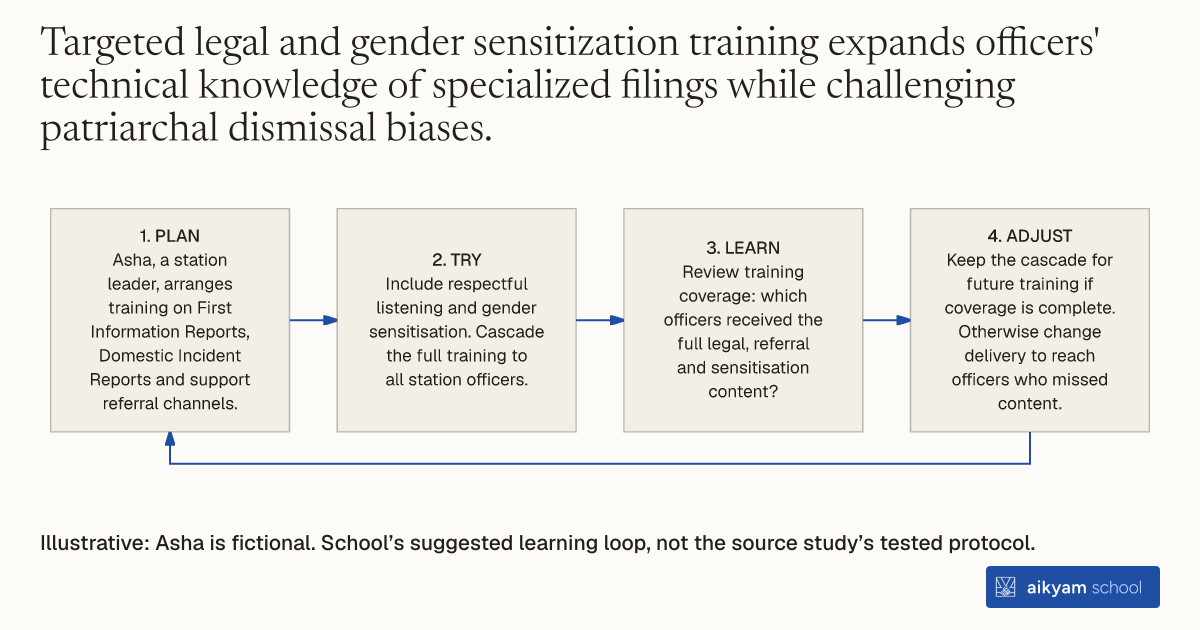
Try, learn and adjust
Check officer training reaches the station
- Plan: Asha, a station leader, arranges training on First Information Reports, Domestic Incident Reports and support referral channels.
- Try: Include respectful listening and gender sensitisation. Cascade the full training to all station officers.
- Learn: Review training coverage: which officers received the full legal, referral and sensitisation content?
- Adjust: Keep the cascade for future training if coverage is complete. Otherwise change delivery to reach officers who missed content.
Illustrative: Asha is fictional. School’s suggested learning loop, not the source study’s tested protocol.
See source →School's suggested, untested loop: observe training coverage and content; training completion alone does not establish changes in reporting.
How
When to use
Many police officers lack legal knowledge on filing specialized violence reports and resist registering crimes against women due to patriarchal norms or political pressure. Officers frequently hold dismissal biases, believing abuse allegations are unfounded or prioritizing family reconciliation over law enforcement. This method trains police officers to properly register cases of gender-based violence and adopt empathetic intake practices.
Train police officers on statutory protocols for registering gender-based violence complaints and respectful victim engagement.
- Police research and training personnel conduct training sessions for station officers on legal procedures for filing First Information Reports and Domestic Incident Reports.
- Instructors deliver lessons on proper communication channels and inter-agency coordination with state and civil society support organizations.
- Facilitators lead gender sensitization modules urging officers to listen to women's claims without dismissing them out of hand.
- Station leadership cascade full training down to all officers at the police station level.
Why it works
This increases officer capacity and willingness to record complaints rather than dismissing them or forcing informal reconciliation.
Example
The Madhya Pradesh Police Research and Training Department trained officers across 120 help desk police stations in 12 districts, achieving full station-level training implementation in 67 percent of stations as of December 2019.
About the study
Participants
180 police stations across 12 districts in Madhya Pradesh, India, serving average catchment populations of 130,000 citizens.
Study Design
Randomized controlled trial comparing 61 regular help desk stations, 59 woman-run help desk stations, and 60 control stations evaluated from May 2019 to October 2020.
Results
Trained help desk stations filed 1,905 additional Domestic Incident Reports (1.5 per month versus 0.05 in control) and 3,360 additional First Information Reports (14 percent increase over control), with visitor comfort reaching 3.39 out of 4 in higher training quality stations.