Try, learn and adjust
Check civil complaint paperwork reaches magistrates
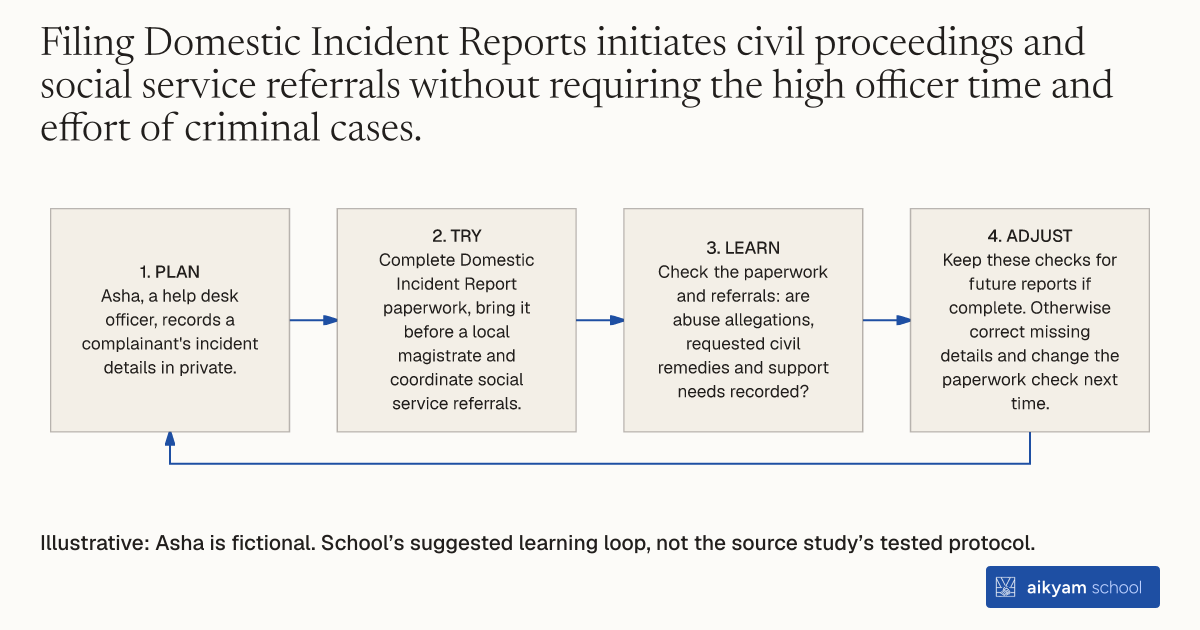
- Plan: Asha, a help desk officer, records a complainant's incident details in private.
- Try: Complete Domestic Incident Report paperwork, bring it before a local magistrate and coordinate social service referrals.
- Learn: Check the paperwork and referrals: are abuse allegations, requested civil remedies and support needs recorded?
- Adjust: Keep these checks for future reports if complete. Otherwise correct missing details and change the paperwork check next time.
Illustrative: Asha is fictional. School’s suggested learning loop, not the source study’s tested protocol.
See source →School's suggested, untested loop: observe civil report details, submission and support referrals; this check does not establish court outcomes.
How
When to use
Many female victims of gender-based violence require civil protection orders and social service support rather than criminal prosecution. Police officers historically registered near zero Domestic Incident Reports due to unfamiliarity with the procedure and inter-agency coordination requirements with local magistrates. This method uses designated police help desks and officer training to consistently file Domestic Incident Reports for female complainants.
File Domestic Incident Reports to initiate civil proceedings and social service referrals for female survivors of gender-based violence.
- Help desk officers receive female complainants in private intake spaces to record incident details.
- Station officers complete Domestic Incident Report paperwork detailing abuse allegations and requested civil remedies.
- Help desk personnel bring completed paperwork before local magistrates to initiate civil court proceedings.
- Station officers coordinate referrals to social service agencies for legal assistance, housing, and social support.
Why it works
Structured training on reporting protocols overcomes officers' unfamiliarity with the procedure and enables both male and female officers to register civil complaints.
Example
Help desk officers in Madhya Pradesh police stations filed 1,905 additional Domestic Incident Reports across 12 districts during the study.
About the study
Participants
180 police stations across 12 districts in Madhya Pradesh, India, serving average station catchment populations of 130,000 citizens.
Study Design
Randomized controlled trial comparing 61 regular help desk stations, 59 woman-run help desk stations, and 60 control stations evaluated from May 2019 to October 2020.
Results
Help desk stations registered an average of 1.5 Domestic Incident Reports per month compared to 0.05 in control stations, resulting in 1,905 additional reports filed with similar gains across male- and female-led desks.