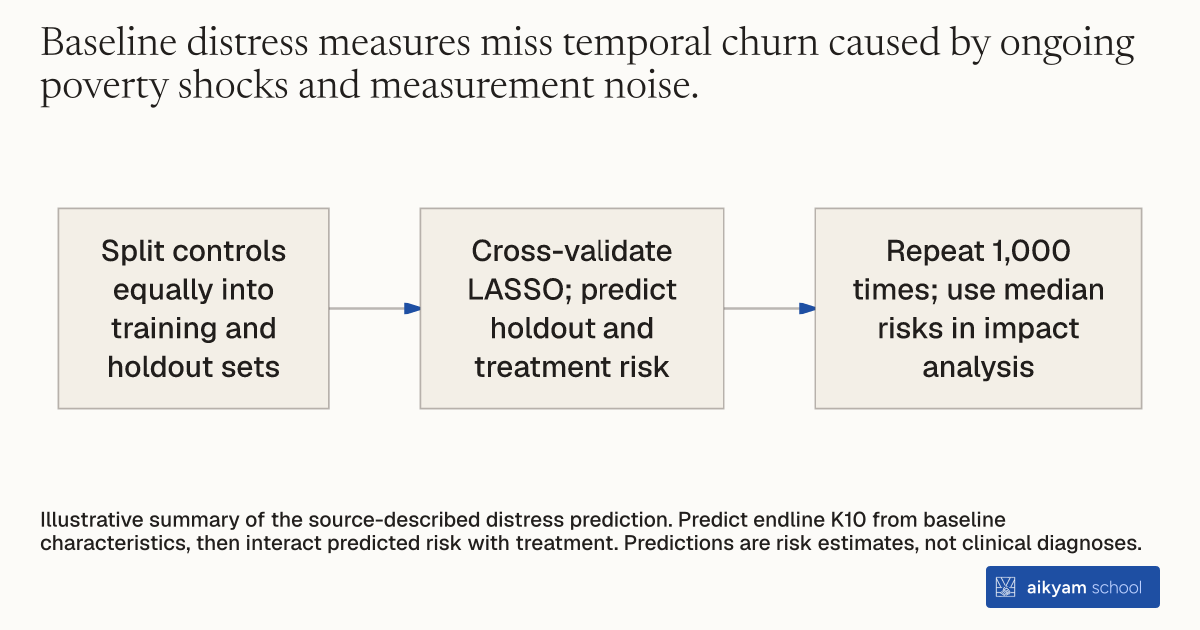
Research steps
Predict future distress using baseline data
- Split controls equally into training and holdout sets
- Cross-validate LASSO; predict holdout and treatment risk
- Repeat 1,000 times; use median risks in impact analysis
Illustrative summary of the source-described distress prediction. Predict endline K10 from baseline characteristics, then interact predicted risk with treatment. Predictions are risk estimates, not clinical diagnoses.
See source →How
When to use
Poor rural populations experience high rates of psychological distress and temporal churn between mental health states over time. Relying solely on baseline mental distress screening misidentifies who will become distressed later and misses vulnerable individuals. This method identifies individuals at high risk of future mental health deterioration to target preventive interventions effectively.
Predict future psychological distress vulnerability by fitting a penalized machine learning model on control group baseline covariates using cross-validated LASSO.
- Split the control group sample randomly into equal training and holdout testing sets.
- Select baseline predictor variables including demographics, asset wealth, trauma history, and baseline distress items.
- Fit a Least Absolute Shrinkage and Selection Operator (LASSO) regression model on the training set using k-fold cross-validation to select parameters and predict endline Kessler K10 scores.
- Calculate predicted endline distress risk scores for individuals in the holdout control and treatment groups using the fitted model weights.
- Repeat the random sample split, LASSO model estimation, and risk score prediction across 1,000 iterations to generate robust median risk estimates.
- Interact treatment indicators with predicted distress risk scores to estimate heterogeneous program impacts across vulnerability levels.
Why it works
Cross-validated LASSO synthesizes multiple baseline demographic and economic indicators to accurately isolate individuals vulnerable to future mental health decline.
Example
Researchers evaluated 7,445 rural adults in Ghana by splitting control households into training and testing samples, running 1,000 cross-validated LASSO repetitions to predict endline Kessler scores, and evaluating therapy impact heterogeneity across predicted risk percentiles.
About the study
Participants
7,445 adults from poor households across 258 rural communities in Ghana.
Study Design
Cross-validated LASSO machine learning estimation over 1,000 random splits of control training and testing samples, estimating treatment interaction with predicted endline distress.
Results
For every 10 point increase in predicted endline Kessler score, CBT caused a 2.7 point reduction in K10 score and a 0.3 standard deviation improvement in mental health; individuals at the 90th percentile of predicted distress experienced a 2.18 point K10 reduction compared to 0.71 points at the 10th percentile.