Research procedure
Use trial data to guide policy targeting
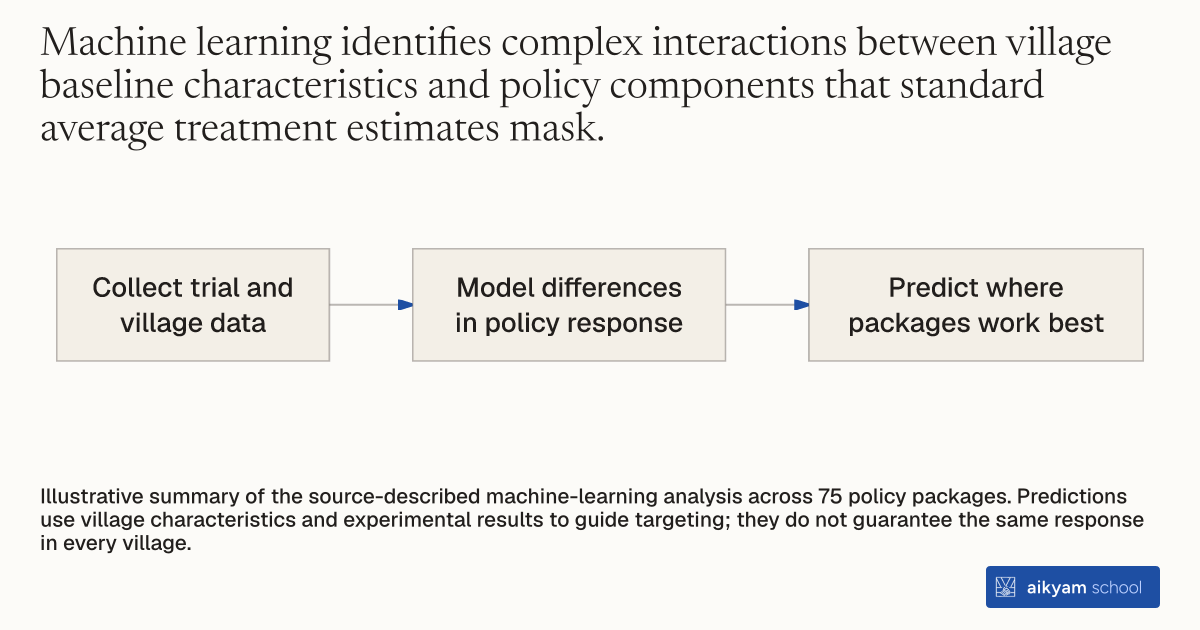
- Collect trial and village data
- Model differences in policy response
- Predict where packages work best
Illustrative summary of the source-described machine-learning analysis across 75 policy packages. Predictions use village characteristics and experimental results to guide targeting; they do not guarantee the same response in every village.
See source →How
When to use
In complex public health trials testing dozens of policy combinations, intervention effects often vary widely across communities. Implementing expensive bundles everywhere can be wasteful, while uniform policies miss high-need areas. Deploy this method to analyze experimental trial data with machine learning algorithms to target policy packages to villages where they are most effective.
Use machine learning algorithms on randomized trial results to predict village-level responsiveness and deploy targeted immunization policy packages.
- Researchers cross-randomize multiple intervention combinations across a wide sample of primary health centers and villages.
- Field staff collect baseline village demographic characteristics, baseline immunization levels, and administrative vaccination data on tablet devices.
- Econometricians apply machine learning techniques to the multi-arm trial dataset to evaluate treatment effect heterogeneity across villages.
- Algorithms predict which specific village characteristics correlate with high responsiveness to given policy packages.
- Program managers allocate expensive policy bundles exclusively to predicted low-coverage villages where impacts and cost-effectiveness are maximized.
Why it works
This allows decision-makers to concentrate resources in areas with low baseline coverage where fixed program costs are spread over many newly vaccinated children.
Example
In Haryana, India, researchers used machine learning algorithms across 75 cross-randomized policy packages in 140 primary health centers, finding that the full package increased immunization six-fold in predicted low-coverage villages while avoiding wasteful spending in high-baseline areas.
About the study
Participants
Caregivers and infants across 140 primary health centers, 755 subcenters, and 912 villages in Haryana, India.
Study Design
A randomized controlled trial combining experimental data across 75 policy bundles with machine learning models to ascertain optimal, cost-effective policy targeting rules based on village characteristics.
Results
In predicted low-coverage villages where the full package was most effective, full immunization rates increased six-fold (500 percent), raising on-time measles vaccination from 13 percent to 61 percent without increasing the cost per child compared to standard care.