Research procedure
Compare nearby and distant control villages
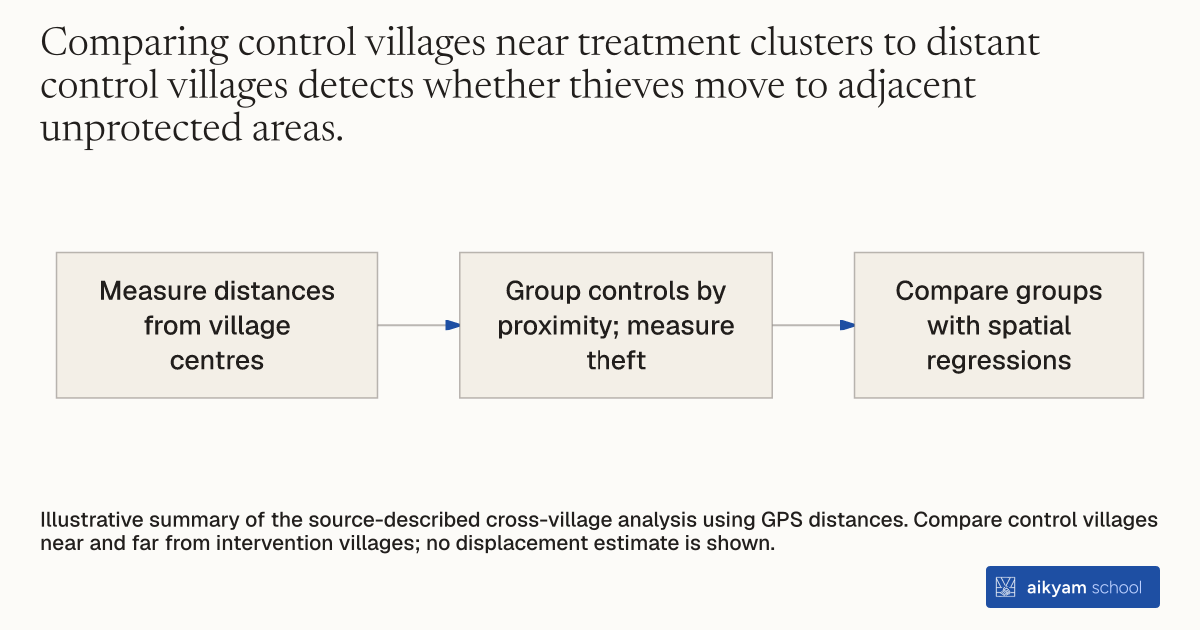
- Measure distances from village centres
- Group controls by proximity; measure theft
- Compare groups with spatial regressions
Illustrative summary of the source-described cross-village analysis using GPS distances. Compare control villages near and far from intervention villages; no displacement estimate is shown.
See source →How
When to use
Evaluating localized crime prevention or security interventions risks overestimating effectiveness if crime simply shifts to nearby unprotected areas. Standard cluster-randomized trials may miss geographic crime displacement or spatial security benefits across village borders. This method measures cross-border spatial spillovers to verify whether safety gains persist at broader regional scales.
Measure spatial crime displacement and security spillovers by evaluating crime outcomes across geographic distance thresholds from treatment villages.
- Calculate the spatial distance from each control village centroid to the nearest intervention village centroid using recorded GPS coordinates.
- Categorize control villages into sequential distance bands or median-split proximity groups relative to treatment village clusters.
- Measure reported crop theft occurrence and perceived security among control households located in near-treatment control villages.
- Compare crime outcomes in near-treatment control villages against far-treatment control villages located beyond potential spillover zones.
- Estimate spatial interaction regression models to test for displacement versus general deterrence spillovers across administrative boundaries.
Why it works
Spatial distance modeling isolates localized crime deterrence from broader geographic displacement effects.
Example
A researcher analyzed geographic crime spillovers across 76 villages in Migori County, Kenya during a watchman trial. The analysis compared control villages located below the median distance to treatment village centroids against control villages located farther away, demonstrating zero crime displacement.
About the study
Participants
585 smallholding farmers across 76 villages in Suna East, Suna West, and Uriri sub-counties in Migori County, Kenya.
Study Design
Spatial regression analysis comparing crime outcomes in control villages at varying distance bands from treatment villages following a cluster-randomized trial.
Results
Control villages located closest to treatment villages showed no increase in crop theft or security concerns, confirming that watchman deployment caused zero spatial displacement of farm theft to neighboring villages.