Research survey
Measure suspicion, grievances and disputes
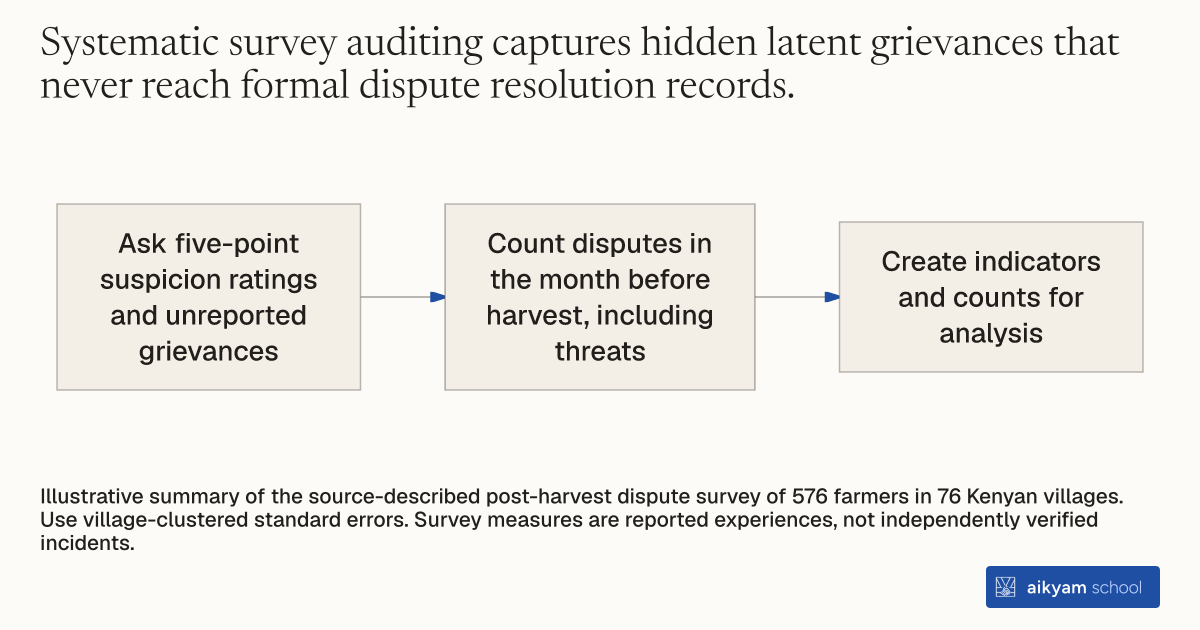
- Ask five-point suspicion ratings and unreported grievances
- Count disputes in the month before harvest, including threats
- Create indicators and counts for analysis
Illustrative summary of the source-described post-harvest dispute survey of 576 farmers in 76 Kenyan villages. Use village-clustered standard errors. Survey measures are reported experiences, not independently verified incidents.
See source →How
When to use
Insecure farm property rights trigger unexpressed grievances and violent neighbor disputes over suspected crop theft. Formal institutions like local chiefs often fail to resolve minor farm interference due to social costs and lack of evidence. This method audits latent grievances and active interpersonal disputes to measure how security interventions reduce community conflict.
Audit local conflict and unexpressed grievances by administering structured dispute tracking modules during post-harvest household surveys.
- Measure farmer suspicion toward neighbors and strangers using five-point agreement scales regarding farm interference during the month before harvest.
- Record unexpressed grievances by asking farmers whether they experienced neighbor interference that they chose not to confront or report to authorities.
- Count total interpersonal farm interference disputes experienced with neighbors during the month prior to harvest.
- Categorize disputes by intensity to record the exact count of disputes involving threats or verbal aggression.
- Standardize responses into binary indicators and integer counts to evaluate changes in community social cohesion.
Why it works
Distinguishing mild disputes from aggressive confrontations reveals how improved property security prevents minor property infractions from escalating into violent local conflicts.
Example
Researchers audited local conflict among 576 smallholders across 76 villages in Migori County, Kenya at endline following a watchman intervention. Providing farm security reduced suspicion of neighbors by 27 percentage points, cut unexpressed grievances by 14 percentage points, and lowered angry disputes by 0.39 occurrences per month.
About the study
Participants
576 smallholding farmers across 76 villages in Suna East, Suna West, and Uriri sub-counties, Migori County, Kenya.
Study Design
Survey-based dispute auditing module administered at endline in a cluster-randomized trial, evaluated using OLS regression specifications with village-clustered standard errors.
Results
Watchman provision reduced high suspicion of neighbor interference by 27.2 percentage points (p < 0.01; non-matched mean = 60%), cut unexpressed grievances by 10.7 to 14 percentage points (p < 0.05; non-matched mean = 27%), decreased total monthly neighbor disputes by 0.465 occurrences (p < 0.01; non-matched mean = 0.98), and reduced angry disputes involving threats or aggression by 0.322 to 0.39 occurrences (p < 0.05; non-matched mean = 0.61).