Try, learn and adjust
Check garment labels carry the shop number
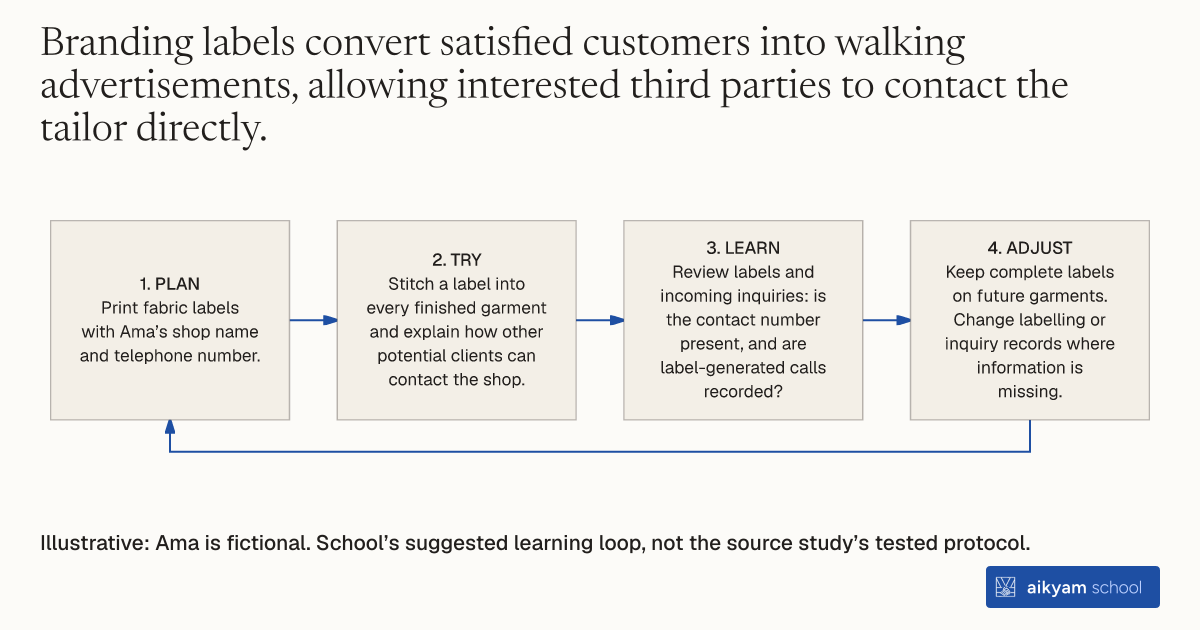
- Plan: Print fabric labels with Ama’s shop name and telephone number.
- Try: Stitch a label into every finished garment and explain how other potential clients can contact the shop.
- Learn: Review labels and incoming inquiries: is the contact number present, and are label-generated calls recorded?
- Adjust: Keep complete labels on future garments. Change labelling or inquiry records where information is missing.
Illustrative: Ama is fictional. School’s suggested learning loop, not the source study’s tested protocol.
See source →School’s suggested, untested loop. Observe labels, telephone inquiries and orders; do not infer profit gains from labels alone.
How
When to use
Microenterprise tailors rely on word-of-mouth recommendations, but admirers of finished garments have no direct way to contact the maker. Affixing physical labels with the shop telephone number to finished clothing turns completed garments into mobile advertisements. This method serves small custom garment producers seeking to acquire new customers without media advertising.
Attach permanent physical labels containing the shop telephone number to all finished garments.
- Purchase or print fabric tags displaying the shop name and telephone contact number.
- Stitch one contact label into every completed garment prior to client delivery.
- Inform clients that the label allows acquaintances to contact the shop directly for garment orders.
- Track incoming client telephone inquiries generated by garment labels during weekly business operations.
- Receive custom orders from new phone-in clients and schedule fittings in the shop.
Example
Under guidance from an Ernst & Young consultant, a 28-year-old seamstress named Sarah in Accra, Ghana, attached labels with her phone number to her products so people who saw her clothes could call her. Combined with record keeping and ready-to-wear production, Sarah expanded her operations and raised her monthly profits from 90 cedis in December 2008 to 333 cedis in December 2010.
About the study
Participants
160 urban microenterprise tailors and seamstresses in Accra, Ghana.
Study Design
Randomized Controlled Trial evaluating marketing guidance and business practice adoption across 8 survey waves over two years.
Results
Tailors receiving consulting implemented marketing innovations such as branding tags and customer outreach, contributing to an initial 5.65 percentage point increase in business practice adoption at 6 months (p < 0.01), though aggregate profits across the full treatment group showed no statistically significant long-term increase relative to controls.