Try, learn and adjust
Check a job role fits the person
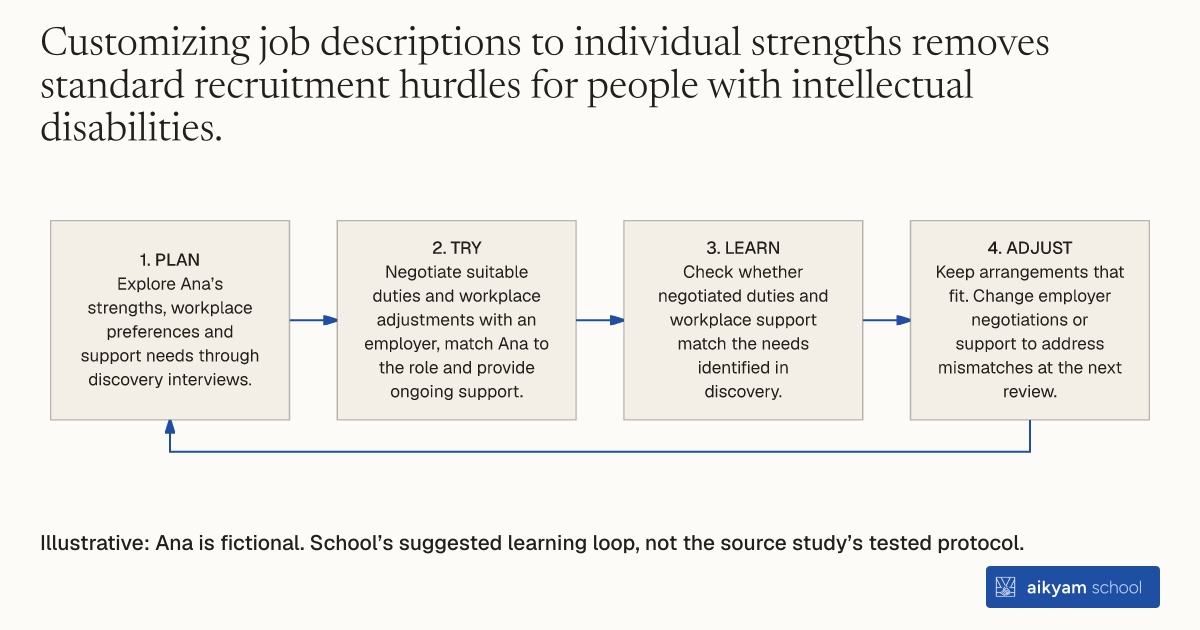
- Plan: Explore Ana’s strengths, workplace preferences and support needs through discovery interviews.
- Try: Negotiate suitable duties and workplace adjustments with an employer, match Ana to the role and provide ongoing support.
- Learn: Check whether negotiated duties and workplace support match the needs identified in discovery.
- Adjust: Keep arrangements that fit. Change employer negotiations or support to address mismatches at the next review.
Illustrative: Ana is fictional. School’s suggested learning loop, not the source study’s tested protocol.
See source →School’s suggested, untested loop: observe job fit, workplace adjustments and ongoing support for a participant with intellectual or developmental disabilities.
How
When to use
People with intellectual and developmental disabilities face exceptionally low labor market participation rates and structural recruitment barriers. Traditional standardized employment services fail to adapt workplace vacancies and onboarding processes to individual capabilities. This method delivers intensive personalized discovery, employer negotiation, and workplace support to integrate individuals with intellectual disabilities into employment.
Deliver intensive personalized employment support and customized job negotiation for individuals with intellectual and developmental disabilities.
- Caseworkers conduct individual discovery interviews with participants to map personal strengths, workplace preferences, and support needs.
- Advisors identify suitable local businesses and conduct tailored interviews with employers to negotiate customized job descriptions and workplace accommodations.
- Caseworkers match participants to adapted job vacancies aligned with their specific capabilities.
- Advisors provide continuous on-the-job support and monitoring to ensure smooth workplace integration and ongoing social inclusion.
Why it works
Intensive caseworker support and employer negotiation align job tasks with participant capabilities while boosting social inclusion and overall well-being.
Example
Plena Inclusión implemented the Customised Employment Methodology across 13 regions in Spain for 435 individuals with intellectual and developmental disabilities over eleven months. Caseworkers conducted in-depth discovery, negotiated tailored job roles with local employers, and provided continuous support. The intervention increased weekly hours worked by 2.3 hours, raised total work contracts by 0.14 per person, and boosted participation in training activities, volunteering, social inclusion, and overall well-being.
About the study
Participants
435 individuals with intellectual and developmental disabilities across 13 regions in Spain (232 treatment group, 203 comparison group).
Study Design
Randomised Controlled Trial (RCT) evaluating an 11-month Customised Employment Methodology intervention implemented by Plena Inclusión.
Results
The program increased weekly hours worked by 2.3 hours (73 percent increase over comparison) and work contracts by 0.14 (45 percent increase), while boosting training participation, social inclusion, volunteering, and overall well-being, though it did not increase overall employment rate at endline.