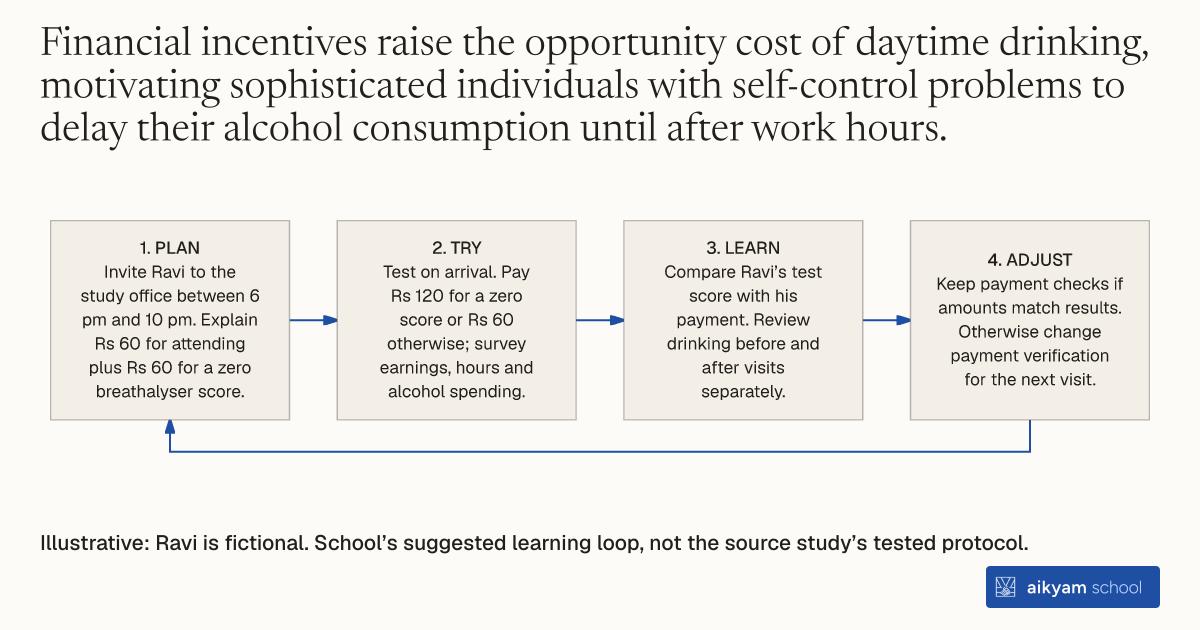
Try, learn and adjust
Check sobriety payments match breathalyser results
- Plan: Invite Ravi to the study office between 6 pm and 10 pm. Explain Rs 60 for attending plus Rs 60 for a zero breathalyser score.
- Try: Test on arrival. Pay Rs 120 for a zero score or Rs 60 otherwise; survey earnings, hours and alcohol spending.
- Learn: Compare Ravi’s test score with his payment. Review drinking before and after visits separately.
- Adjust: Keep payment checks if amounts match results. Otherwise change payment verification for the next visit.
Illustrative: Ravi is fictional. School’s suggested learning loop, not the source study’s tested protocol.
See source →School’s suggested learning loop: observe test results, payments and drinking timing; daytime sobriety does not establish lower total daily drinking.
How
When to use
Low-income manual laborers frequently engage in daytime drinking, which impairs self-control and intertemporal decision-making. Standard unconditional wages or unstructured welfare programs do not alter daytime drinking incentives. Use this method to reduce daytime inebriation among working populations through conditional financial rewards tied to objective breathalyzer measures.
Offer conditional daily financial bonuses to workers who arrive sober at a study office as verified by an objective breathalyzer test.
- Field staff establish a local office near participants' worksites operating during daily evening hours from 6 pm to 10 pm.
- Staff offer participants a base payment of Rs 60 for attending the office visit and an additional conditional bonus of Rs 60 if their breathalyzer score is zero.
- Surveyors measure blood alcohol concentration using a precision breathalyzer test upon each participant's arrival.
- Surveyors disburse Rs 60 to participants testing positive for alcohol and Rs 120 to participants testing completely sober.
- Surveyors administer a daily questionnaire recording labor earnings, hours worked, and alcohol expenditures.
Example
For 15 study days in Chennai, cycle-rickshaw drivers assigned to sobriety incentives received Rs 60 for attending an evening office visit plus Rs 60 for testing sober on a breathalyzer. The incentives increased the proportion of drivers arriving sober by 13 percentage points (a 33 percent increase over the control group mean of 39 percent) and reduced reported drinks consumed before office visits by 0.96 standard drinks, though overall daily drinking and expenditures remained largely unchanged as drivers shifted drinking to later in the evening.
About the study
Participants
229 male cycle-rickshaw drivers aged 25 to 60 in Chennai, India.
Study Design
Randomized controlled trial comparing financial sobriety incentives (Rs 60 base + Rs 60 sober bonus) against an unconditional Rs 90 control payment over 15 treatment days.
Results
Sobriety incentives increased daytime sobriety by 13 percentage points (or 33 percent) and reduced pre-visit drinking by 0.96 standard drinks, while overall daily drinking decreased by an statistically insignificant 0.30 standard drinks and daily expenditures fell by an insignificant Rs 8.06.