Research measurement
Measure drinking and work at evening visits
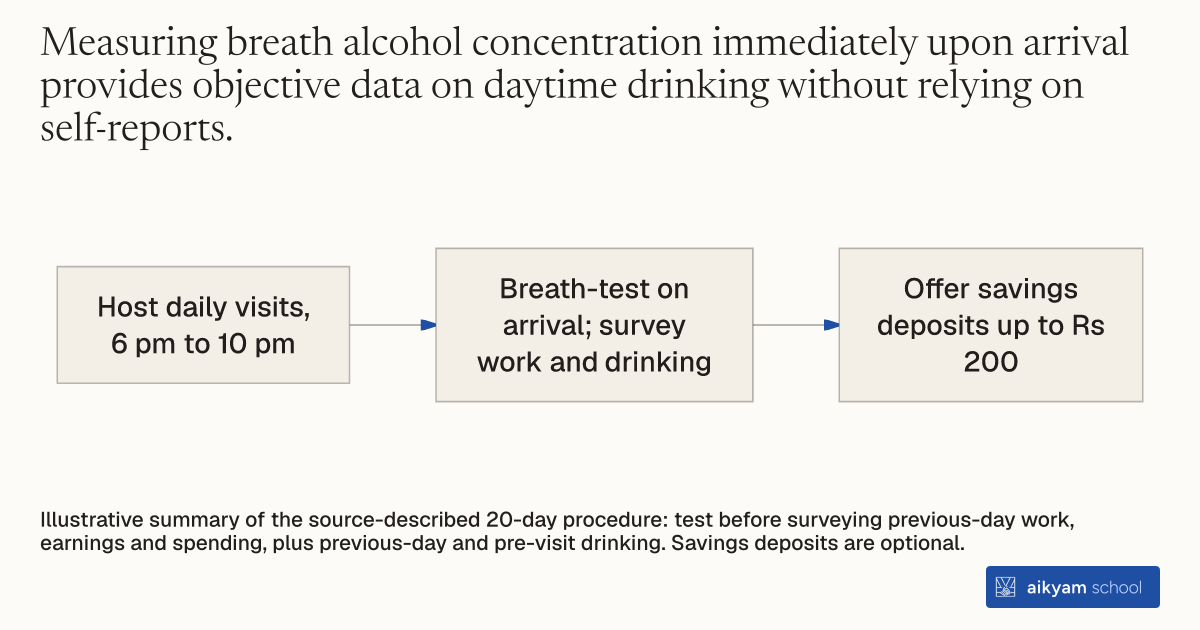
- Host daily visits, 6 pm to 10 pm
- Breath-test on arrival; survey work and drinking
- Offer savings deposits up to Rs 200
Illustrative summary of the source-described 20-day procedure: test before surveying previous-day work, earnings and spending, plus previous-day and pre-visit drinking. Savings deposits are optional.
See source →How
When to use
Field experiments tracking alcohol consumption, daily labor earnings, and savings among manual workers face recall bias if measured infrequently. This method uses structured daily evening visits combining objective breathalyzer tests and high-frequency surveys. Use this approach to gather precise individual-level time-series data on acute inebriation, labor supply, daily income, and expenditure patterns.
Require trial participants to visit a local field office every evening during specified hours to undergo breathalyzer testing and structured high-frequency surveying.
- Field surveyors host study participants at a dedicated office located near their work area daily between 6 pm and 10 pm.
- Surveyors immediately administer a breathalyzer test using a precision device to record blood alcohol concentration.
- Surveyors administer a structured questionnaire recording labor supply, daily earnings, work hours, and expenditures from the previous day.
- Surveyors collect self-reported drinking data, including timing of the first drink and alcohol quantities consumed both on the previous day and on the current day before the visit.
- Surveyors offer participants the opportunity to deposit up to Rs 200 into individual savings lockboxes housed at the study office.
Why it works
Administering retrospective surveys right after testing ensures high recall accuracy for daily labor hours, earnings, and expenditures.
Example
Over 20 study days in Chennai, 229 cycle-rickshaw drivers attended daily office visits between 6 pm and 10 pm. High-frequency measurements achieved an overall attendance rate of 88.4 percent, capturing average Control Group blood alcohol levels of 0.09 percent, daily earnings of Rs 287.71, and average daily office savings of Rs 20.42.
About the study
Participants
229 male cycle-rickshaw drivers aged 25 to 60 in Chennai, India.
Study Design
20-day consecutive evening office measurement protocol (6 pm to 10 pm) combining precision breathalyzer testing, structured questionnaires, and daily savings options.
Results
Achieved 88.4 percent overall participant attendance across study days; recorded control group mean blood alcohol concentration of 0.09 percent, daily earnings of Rs 287.71, and average daily savings of Rs 20.42.