Research audit
Observe responses to decoy reports
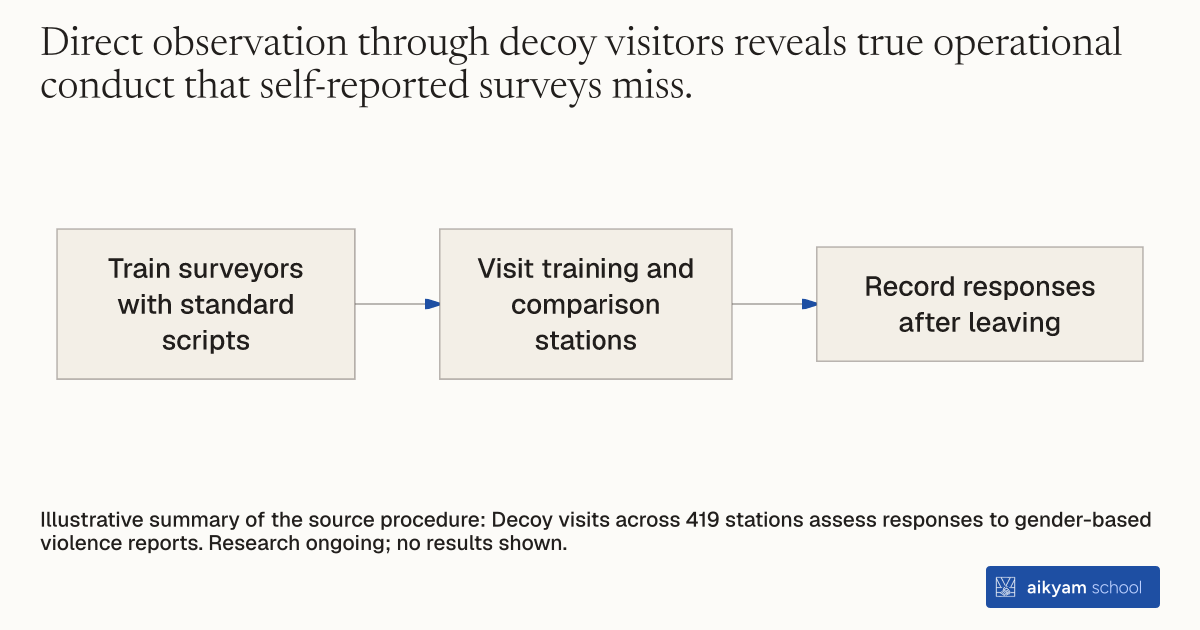
- Train surveyors with standard scripts
- Visit training and comparison stations
- Record responses after leaving
Illustrative summary of the source procedure: Decoy visits across 419 stations assess responses to gender-based violence reports. Research ongoing; no results shown.
See source →How
When to use
Self-reported surveys often fail to reflect actual officer behavior during citizen interactions. Police personnel may give socially desirable answers while continuing dismissive behavior in person. Use decoy reporting tests to measure whether officers apply gender-sensitivity training in real-world police station settings.
Measure officers' practical application of gender-sensitive training by sending undercover surveyors to report gender-based violence incidents at police stations.
- Design standardized scenario scripts depicting common gender-based violence complaints for field auditors.
- Recruit and train female field surveyors from a research firm to act as decoy crime victims.
- Deploy undercover surveyors to visit treatment and comparison police stations without advance notice.
- Attempt to report gender-based violence incidents to on-duty police personnel following the scripted scenarios.
- Record officer responses immediately after leaving, noting empathy levels, registration willingness, and victim-blaming behaviors.
Why it works
Audit tests evaluate real-time responsiveness and survivor-centered practices under actual working conditions.
Example
Researchers deployed surveyors from DAI Research & Advisory Services to perform decoy reporting tests across 419 police stations in Bihar, India to evaluate officer responsiveness to gender-based violence reports.
About the study
Participants
419 police stations in Bihar, India.
Study Design
Randomized controlled trial comparing 217 treatment police stations with 202 comparison police stations using decoy visits.
Results
Research ongoing; results forthcoming.