Research survey
Compare police attitudes before and after
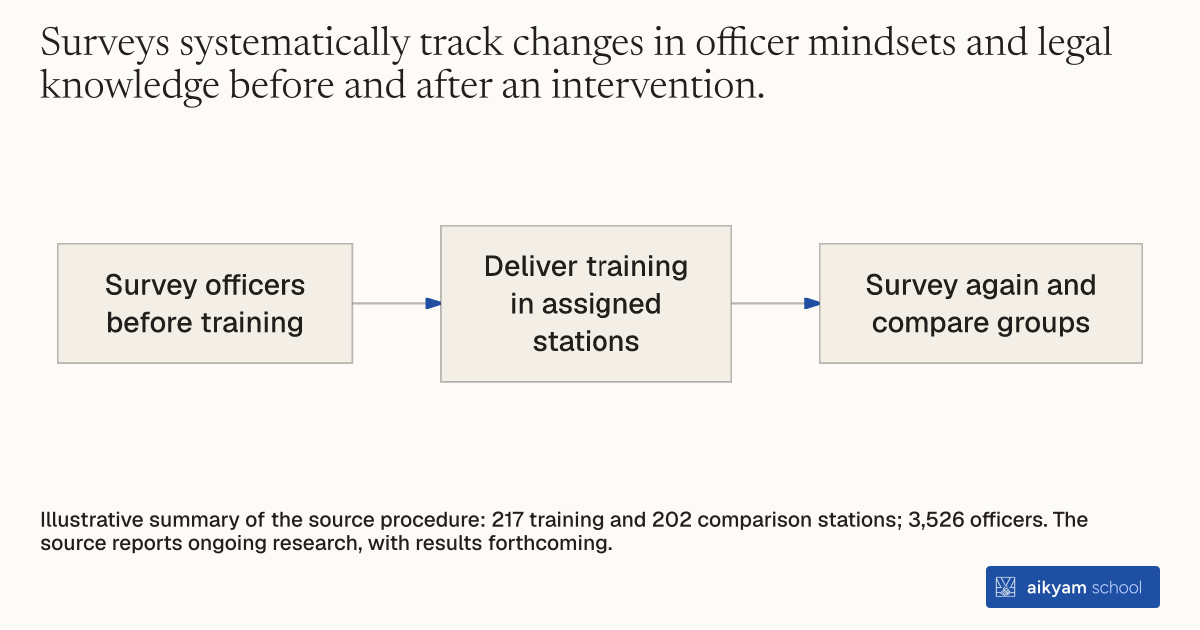
- Survey officers before training
- Deliver training in assigned stations
- Survey again and compare groups
Illustrative summary of the source procedure: 217 training and 202 comparison stations; 3,526 officers. The source reports ongoing research, with results forthcoming.
See source →How
When to use
Police officers often hold dismissive beliefs about gender-based violence and false crime reporting. Evaluating changes in officer mindsets requires baseline and endline measurement. Administer pre- and post-intervention attitude surveys to evaluate changes in law enforcement beliefs and legal knowledge.
Survey police officers before and after training interventions to evaluate changes in gender attitudes and legal knowledge.
- Design a survey instrument measuring officer beliefs on gender-based violence reporting, victim-blaming, and legal technical skills.
- Administer the baseline survey to police officers across targeted police stations prior to the training intervention.
- Deliver the gender-sensitization intervention to designated officer groups.
- Administer the endline survey to police officers following the completion of the training sessions.
- Compare baseline and endline survey data across treatment and comparison police stations.
Why it works
Comparative analysis between groups isolates training effects from external influences.
Example
Researchers administered attitude surveys to 3,526 police officers in Bihar, India before and after an intensive gender-sensitization training to measure shifts in gender norms and legal knowledge.
About the study
Participants
3,526 police officers in 419 police stations across Bihar, India.
Study Design
Randomized controlled trial comparing baseline and endline survey responses across 217 treatment stations and 202 comparison stations.
Results
Research ongoing; results forthcoming.