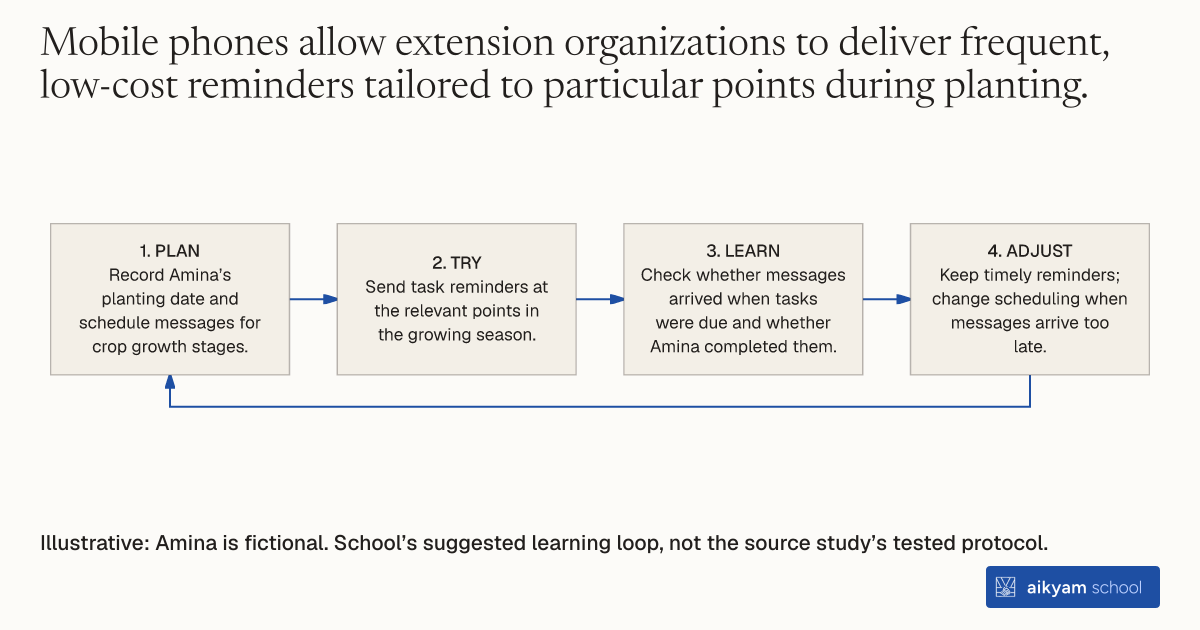
Try, learn and adjust
Check reminders reach farmers when tasks are due
- Plan: Record Amina’s planting date and schedule messages for crop growth stages.
- Try: Send task reminders at the relevant points in the growing season.
- Learn: Check whether messages arrived when tasks were due and whether Amina completed them.
- Adjust: Keep timely reminders; change scheduling when messages arrive too late.
Illustrative: Amina is fictional. School’s suggested learning loop, not the source study’s tested protocol.
See source →Observe message timing and task completion; this check does not establish yield effects. School suggests this learning loop; it was not tested by the source.
How
When to use
Traditional extension services struggle to deliver timely agronomic guidance to remote smallholder farmers. Infrequent advisory visits fail to align with critical crop growth stages, leading to suboptimal management decisions. This method delivers automated, time-sensitive SMS alerts to remind smallholders to perform specific farming tasks throughout the growing season.
Send automated, task-specific text message reminders to farmers at key crop growth stages throughout the growing season.
- Extension officers establish a database of enrolled smallholder farmers and track crop planting dates.
- Program administrators schedule automated SMS messages tailored to specific stages of crop development.
- Extension systems automatically broadcast short text reminders to farmers when key agricultural tasks are due.
- Farmers read the time-sensitive reminders on their mobile phones during the growing season.
- Farmers execute recommended crop maintenance tasks on their fields according to the received schedule.
Why it works
Timed reminders address limited attention and behavioral friction, ensuring farmers complete key tasks at optimal moments.
Example
In Kenya, contracted sugarcane farmers received SMS reminders about agricultural tasks timed to coincide with relevant parts of the growing season. This intervention increased farmer crop yields by 8 percent relative to the comparison group at a cost of US\$0.02 per text message while raising farmer revenues by US\$54.
About the study
Participants
Contracted sugarcane smallholder farmers in rural Kenya.
Study Design
Randomized controlled trial testing the impact of task-timed SMS advisory reminders against a comparison group.
Results
Sugarcane farmers who received SMS reminders timed to relevant parts of the growing season experienced an 8 percent increase in crop yields, generated US\$54 in additional revenue per farmer, and cost US\$0.02 per text message.