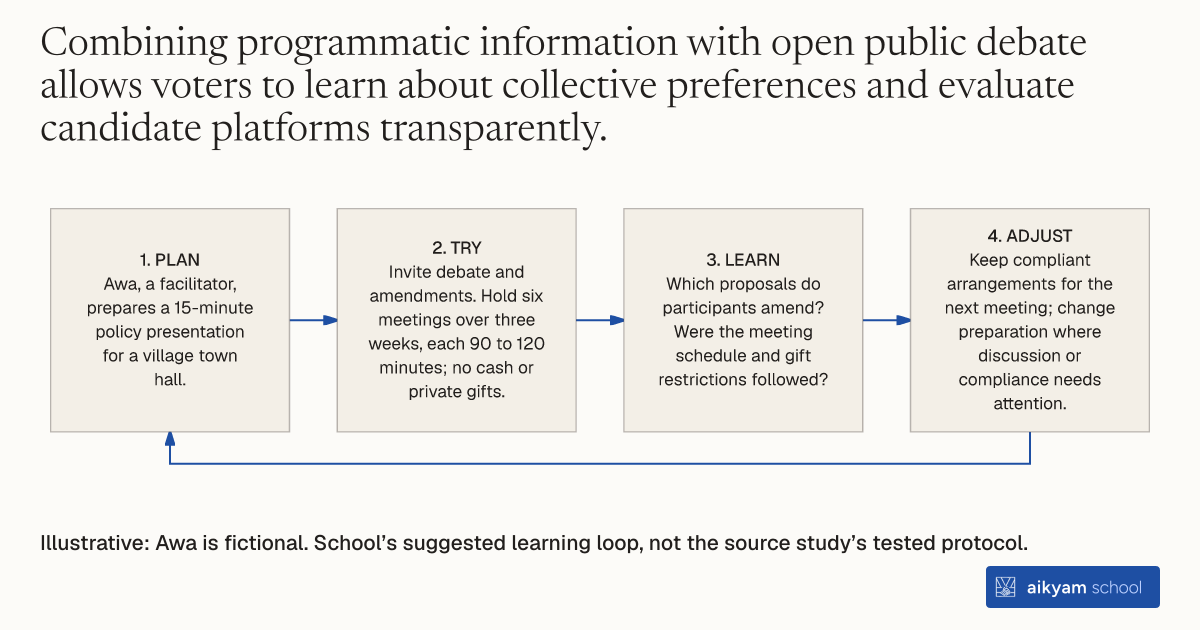
Try, learn and adjust
Check town hall discussion and campaign rules
- Plan: Awa, a facilitator, prepares a 15-minute policy presentation for a village town hall.
- Try: Invite debate and amendments. Hold six meetings over three weeks, each 90 to 120 minutes; no cash or private gifts.
- Learn: Which proposals do participants amend? Were the meeting schedule and gift restrictions followed?
- Adjust: Keep compliant arrangements for the next meeting; change preparation where discussion or compliance needs attention.
Illustrative: Awa is fictional. School’s suggested learning loop, not the source study’s tested protocol.
See source →School’s suggested learning loop, not a tested source procedure. Observe participant amendments, meeting timing and compliance with gift restrictions; this does not establish electoral effects.
How
When to use
Electoral campaigns in developing democracies frequently rely on clientelist rallies involving cash and gift distributions rather than policy debates. Voters lack opportunities to deliberate on programmatic solutions with candidate representatives. Organizing candidate-endorsed deliberative town hall meetings offers voters a public platform to debate evidence-based public goods policies.
Replace traditional clientelist campaign rallies with expert-facilitated deliberative town hall meetings to discuss candidate policy platforms.
- Deploy trained research institute staff to host village town hall meetings on behalf of endorsed political candidates.
- Deliver a 15-minute presentation outlining national governance problems and expert-formulated policy solutions.
- Open the floor to village participants for debate, contextualizing issues and amending proposed policy platforms.
- Host six total meetings per treated village over three weeks preceding election day, lasting 90 to 120 minutes each.
- Permit distribution of campaign promotional materials like calendars and t-shirts while strictly prohibiting cash or private gifts.
Why it works
Public deliberation creates clear benchmarks for politician performance and facilitates voter coordination around public goods provision.
Example
During the 2006 presidential election campaign in Benin, research staff conducted six deliberative town hall meetings across treated villages on behalf of three major presidential candidates. Between 50 and 200 citizens attended each meeting, with overall village attendance reaching 70 percent of the adult population.
About the study
Participants
12 treatment villages across 12 communes in Benin, with 70 percent adult village participation (50 to 200 participants per meeting).
Study Design
Stratified randomized field experiment comparing deliberative town hall campaign meetings against standard clientelist rallies with gifts and cash.
Results
Town hall meetings reduced the clientelism index by 0.227 standard deviations, maintained voter turnout at 81.9 percent, and increased vote share for non-dominant candidates outside their strongholds by 16.8 percentage points.