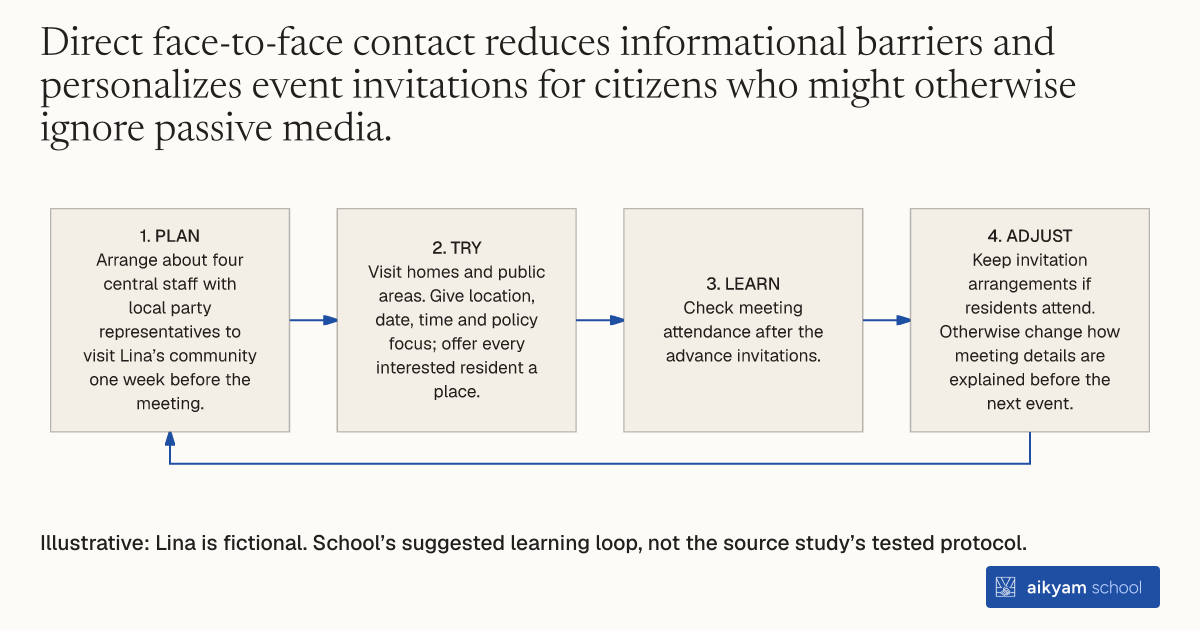
Try, learn and adjust
Check invitations and town-hall attendance
- Plan: Arrange about four central staff with local party representatives to visit Lina’s community one week before the meeting.
- Try: Visit homes and public areas. Give location, date, time and policy focus; offer every interested resident a place.
- Learn: Check meeting attendance after the advance invitations.
- Adjust: Keep invitation arrangements if residents attend. Otherwise change how meeting details are explained before the next event.
Illustrative: Lina is fictional. School’s suggested learning loop, not the source study’s tested protocol.
See source →School’s suggested learning loop, not the source’s tested procedure. Observe meeting attendance. This check does not establish persuasion or vote effects.
How
When to use
A political campaign or civic organization needs to mobilize citizens to attend structured deliberative meetings in local communities. Standard public announcements or passive posters often fail to generate sufficient attendance or reach diverse demographic groups. Deploying dedicated teams directly to households in advance ensures community members receive personal notification about upcoming discussions.
Mobilize community members to attend local deliberative forums by conducting direct door-to-door and public outreach prior to scheduled events.
- Form outreach teams consisting of four central staff coordinators working alongside local party nominees and officers.
- Deploy the outreach teams to target communities exactly one week before scheduled town-hall meetings.
- Visit households door-to-door and engage citizens in busy public areas across the targeted neighborhood.
- Inform residents verbally about the specific location, date, time, and policy focus of the upcoming deliberative meetings.
- Provide open invitations and guarantee a place in the meeting for every citizen who expresses interest in attending.
Why it works
Notifying residents a week in advance gives households adequate time to plan attendance while keeping the upcoming event salient.
Example
In April and May 2013, four staff members from the Center for Popular Empowerment teamed up with representatives from the Akbayan and Umalab Ka party-lists across treatment barangays in Metro Manila and Calabarzon. The teams went door-to-door and through public areas one week before each meeting to inform residents about town-hall schedules. Across treatment barangays, this advance mobilization successfully brought an average of 40 participants per meeting, representing 5 percent of registered voters and 8 percent of party-list voters in target communities.
About the study
Participants
39 randomly selected barangays across 13 municipalities in the National Capital Region and Calabarzon region of the Philippines, covering 1,082 survey respondents and precinct election records.
Study Design
Two-stage randomized field experiment testing advance door-to-door mobilization for deliberative campaigns against standard campaign outreach in control areas, evaluated using official precinct data and post-election surveys.
Results
Advance door-to-door mobilization successfully secured attendance averaging 5 percent of registered voters (8 percent of active party-list voters) across treatment barangays, reaching up to 25 percent in smaller barangays like Barangay 738 and Lalakay.