Research procedure
Prepare expert policy proposals
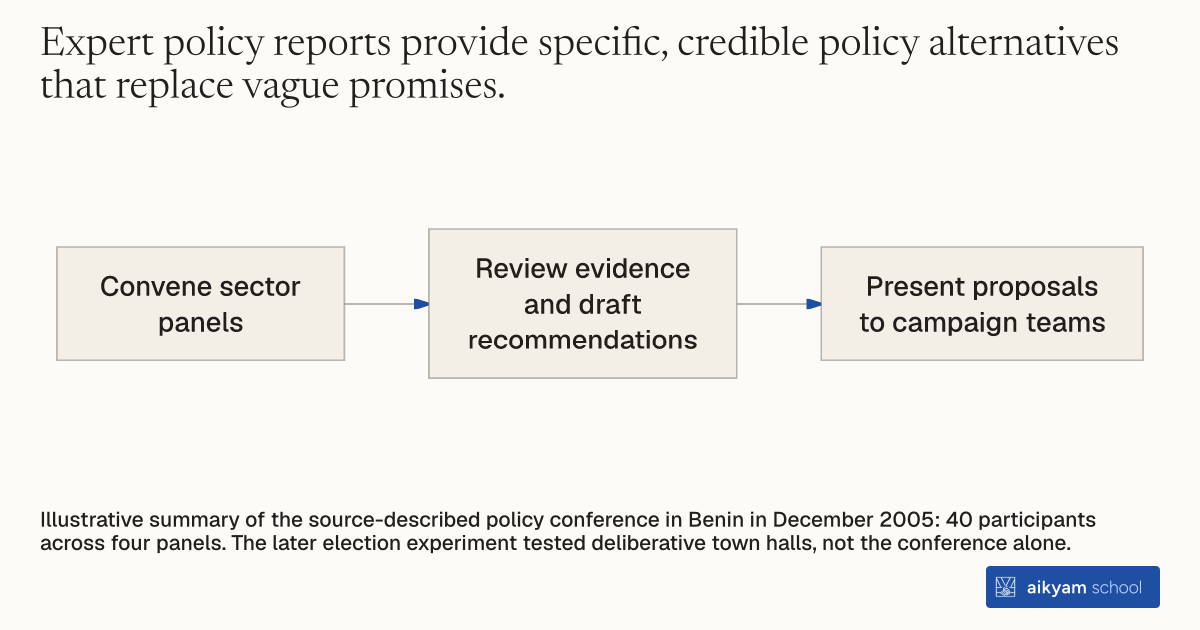
- Convene sector panels
- Review evidence and draft recommendations
- Present proposals to campaign teams
Illustrative summary of the source-described policy conference in Benin in December 2005: 40 participants across four panels. The later election experiment tested deliberative town halls, not the conference alone.
See source →How
When to use
Democratic elections in developing countries often rely on vague, clientelist promises rather than broad policy programs. Political campaigns lack credible policy proposals backed by evidence and expert consensus. Convening academic experts to draft programmatic policy proposals creates an evidence-based foundation for candidates.
Organize a structured policy conference with research experts to synthesize evidence and draft campaign platforms across key public sectors.
- Identify major national governance issues across core public service sectors.
- Convene academic policy experts and practitioners into dedicated sectoral panels.
- Task experts with drafting policy reports evaluating government performance in each sector.
- Formulate specific, actionable policy recommendations grounded in academic research and best practices.
- Present the synthesized sectoral recommendations to political candidate campaign teams for adoption.
Why it works
Structured academic synthesis ensures proposals address broad public goods rather than targeted patronage.
Example
In December 2005 in Benin, researchers organized a policy conference titled "Elections 2006: What policy alternatives?" featuring 40 participants across four panels covering education, public health, governance, and urban planning. Four policy experts synthesized evidence and drafted recommendations, which were subsequently adopted by the campaign teams of four major presidential candidates.
About the study
Participants
40 participants across four policy panels in Benin, informing campaign strategies tested across 45 villages in 12 communes during the 2006 presidential election.
Study Design
Stratified randomized field experiment comparing expert-informed deliberative town hall meetings against standard clientelist rallies.
Results
Adopting expert-formulated platforms in deliberative town halls reduced the clientelism index by 0.227 standard deviations without lowering voter turnout.