Research steps
Vary trainers and local training coverage
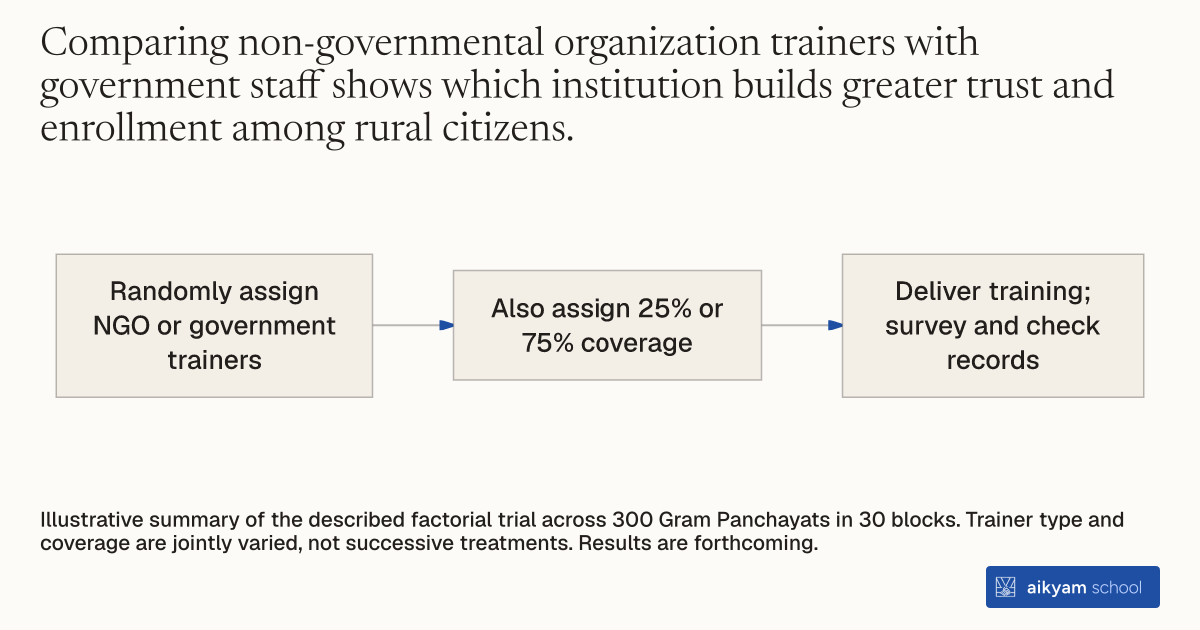
- Randomly assign NGO or government trainers
- Also assign 25% or 75% coverage
- Deliver training; survey and check records
Illustrative summary of the described factorial trial across 300 Gram Panchayats in 30 blocks. Trainer type and coverage are jointly varied, not successive treatments. Results are forthcoming.
See source →How
When to use
In rural development programs, decision-makers often do not know whether non-governmental organization staff or local government officers deliver training more effectively. Furthermore, public agencies must determine whether training a small share or a large majority of local community members creates stronger peer networks and broader administrative uptake. This method systematically varies trainer institution and community coverage density to optimize training delivery for rural women.
Randomly vary the institutional trainer type and local participant coverage density when rolling out administrative training across target communities.
- Program managers divide target blocks and local administrative units into distinct experimental clusters.
- Evaluators assign half of the training clusters to receive instruction from specialized non-governmental organization staff and half to receive instruction from local government program officers.
- Facilitators assign local administrative units to target either a low coverage density of 25 percent of eligible women or a high coverage density of 75 percent of eligible women.
- Assigned trainers deliver identical video-guided administrative modules and account setup support according to their institutional assignment and local coverage target.
- Researchers survey community members and examine administrative records to measure relative impacts on labor participation and information diffusion.
Why it works
Testing low versus high coverage density reveals whether reaching a critical mass of community members generates stronger social network spillovers.
Example
In Madhya Pradesh, India, researchers assigned 300 Gram Panchayats across 30 blocks to test training variations. Programs assigned PRADAN NGO staff or local government MGNREGS officers to deliver training while varying coverage targets between 25 percent and 75 percent of local women across 6,000 surveyed households.
About the study
Participants
6,000 surveyed households across 300 Gram Panchayats in 30 blocks of Madhya Pradesh, India, where 57 percent of surveyed women were aged 15 to 49.
Study Design
Factorial Randomized Controlled Trial across 300 Gram Panchayats, varying trainer identity (PRADAN staff vs. local government staff) and participant coverage density (25 percent vs. 75 percent of local women).
Results
Evaluators designed the trial to measure relative training efficacy between NGO and government facilitators across two saturation thresholds; research is ongoing with results forthcoming.