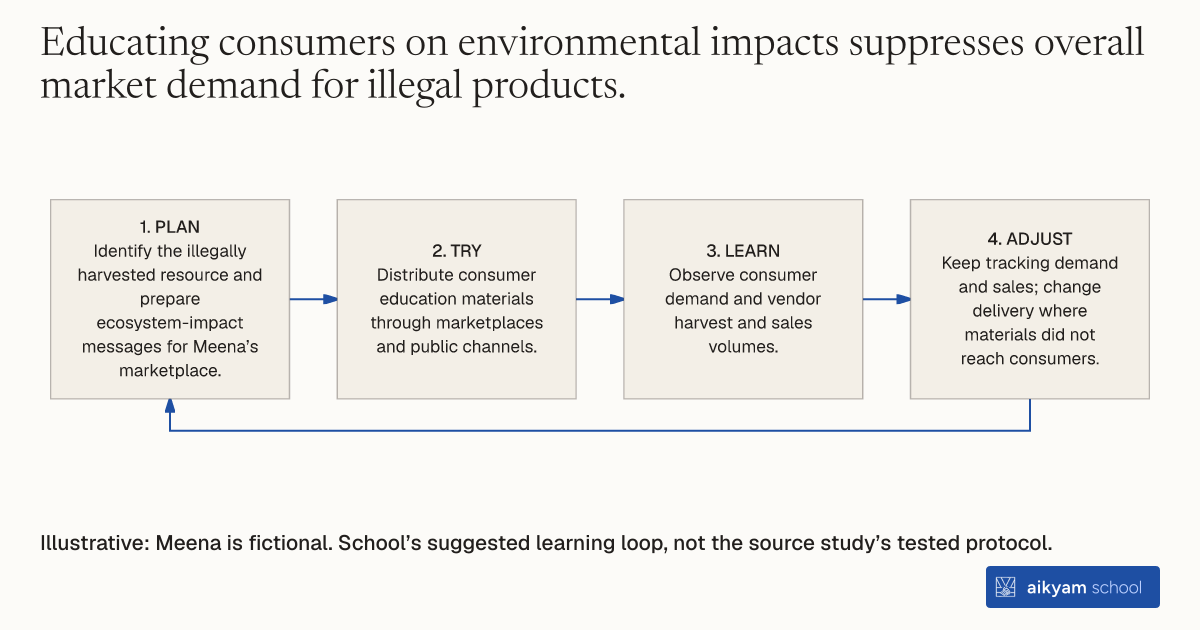
Try, learn and adjust
Check environmental messages reach consumers
- Plan: Identify the illegally harvested resource and prepare ecosystem-impact messages for Meena’s marketplace.
- Try: Distribute consumer education materials through marketplaces and public channels.
- Learn: Observe consumer demand and vendor harvest and sales volumes.
- Adjust: Keep tracking demand and sales; change delivery where materials did not reach consumers.
Illustrative: Meena is fictional. School’s suggested learning loop, not the source study’s tested protocol.
See source →Campaign reach and market demand; do not assume each consumer changes purchases. School’s suggested learning loop, not a source-tested cycle.
How
When to use
Supply-side regulatory enforcement against illegal natural resource harvesting often fails because vendors hide illegal products. Enforcement agencies face high costs tracking down individual sellers across informal markets. This method applies to environmental protection agencies seeking to reduce overexploitation by targeting consumer demand.
Run a public education campaign that informs consumers about the environmental damage caused by purchasing illegally harvested resources.
- The environmental agency identifies a vulnerable natural resource subject to overexploitation by illegal harvesters.
- The agency designs educational campaign materials detailing how purchasing the resource harms local ecosystems.
- The agency distributes these informative materials across consumer marketplaces and public information channels.
- Consumers read the campaign messaging and reduce their market demand for the illegally harvested resource.
- Vendors lower their harvest and sales volumes in response to declining consumer demand in Chile.
Why it works
Lower consumer demand reduces vendor profits from illegal harvesting without requiring high enforcement spending.
Example
In Chile, an environmental education campaign informed consumers about the ecological impacts of consuming hake fish, which successfully reduced demand and proved nearly as effective at curbing overfishing as government enforcement.
About the study
Participants
Fish consumers and marketplace vendors in Chile.
Study Design
Randomized controlled trial comparing a consumer information campaign against varying regulatory monitoring schedules.
Results
Educating consumers on the environmental impacts of consuming hake fish suppressed demand and was nearly as effective as the best enforcement design in reducing overfishing.